The Architecture of Evolution
The Science of Form in Twentieth-Century Evolutionary Biology
Format:Hardback
Publisher:University of Pittsburgh Press
Published:6th Feb '24
£48.95
Available to order, but very limited on stock - if we have issues obtaining a copy, we will let you know.
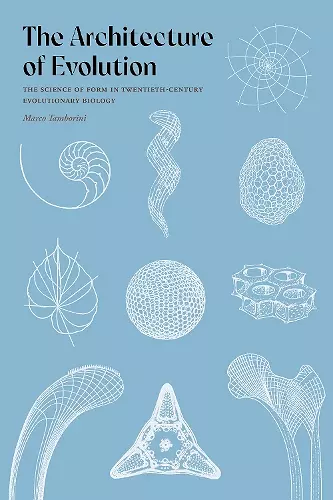
How the History of Morphology Made the Advent of Evolutionary Developmental Biology Possible
In the final decades of the twentieth century, the advent of evolutionary developmental biology (evo-devo) offered a revolutionary new perspective that transformed the classical neo-Darwinian, gene-centered study of evolution.In the final decades of the twentieth century, the advent of evolutionary developmental biology (evo-devo) offered a revolutionary new perspective that transformed the classical neo-Darwinian, gene-centered study of evolution. In _The Architecture of Evolution_, Marco Tamborini demonstrates how this radical innovation was made possible by the largely forgotten study of morphology. Despite the key role morphology played in the development of evolutionary biology since the 1940s, the architecture of organisms was excluded from the Modern Evolutionary Synthesis. And yet, from the beginning of the twentieth century to the 1970s and ’80s, morphologists sought to understand how organisms were built and how organismal forms could be generated and controlled. The generation of organic form was, they believed, essential to understanding the mechanisms of evolution. Tamborini explores how the development of evo-devo and the recent organismal turn in biology involved not only the work of morphologists but those outside the biological community with whom they exchanged their data, knowledge, and practices. Together with architects and engineers, they worked to establish a mathematical and theoretical basis for the study of organic form as a mode of construction, developing and reinterpreting important notions that would play a central role in the development of evolutionary developmental biology in the late 1980s. This book sheds light not only on the interdisciplinary basis for many of the key concepts in current developmental biology but also on contributions to the study of organic form outside the English-speaking world. **PRAISE** "Marco Tamborini’s book is a much-needed history of morphological thought in the twentieth century. It provides an engaging intellectual journey, leading us through biology, architecture, philosophy, engineering, mathematics, politics, and art. This is a highly original contribution that shows how the science of form emerged from an international and interdisciplinary enterprise." ~Maurizio Esposito, University of Lisbon, Portugal
Offers an original discussion of the philosophical and scientific implications of the morphological approaches of the time.
* Journal of the History of Biology *The Architecture of Evolution is a rewarding work, which will be of interest to a wide range of historians, philosophers, and biologists. It provides a window into the rich variety of structuralist approaches to biology, understanding them on their own terms and not merely as antagonists of a functionalist mainstream.
* H-Net Reviews *Experts and beginners alike will find in Tamborini’s text a fluid, intelligible, and fascinating study of the architecture of evolution.
* Isis *Contrary to the standard narrative, Tamborini is painting a picture of an intense intellectual struggle during the 20th century when morphologists were seeking to re-negotiate the role of morphology in 20th century biology. This his- tory turns out to be a highly dynamic story of initial refusal to engage with the achievements of genetics and eventual re-establishment of morphology as an ‘interstitial science’, that, rather than being a center of gravity, became a bridge that connects many disciplinary research programs in biology and beyond.
* Trends in Ecology and Evolution *Marco Tamborini’s book is a much-needed history of morphological thought in the twentieth century. It provides an engaging intellectual journey, leading us through biology, architecture, philosophy, engineering, mathematics, politics, and art. This is a highly original contribution that shows how the science of form emerged from an international and interdisciplinary enterprise.
-- Maurizio Esposito, University of Lisbon, Portugal"The Architecture of Evolution is a major contribution to the historiography of morphology in the twentieth century. Tamborini shows how the riddle of organismal form was a central preoccupation of theoretically and philosophically minded biologists, and he examines how the discipline of morphology was variously conceptualized and pursued in different national and intellectual traditions. It is an exceptionally rich book that will be essential reading for anyone interested in morphology and its relation to evolution."
-- Daniel J. Nicholson, George Mason UniverISBN: 9780822947356
Dimensions: unknown
Weight: unknown
283 pages