Creatures of Reason
John Herschel and the Invention of Science
Format:Hardback
Publisher:University of Pittsburgh Press
Published:31st May '25
Should be back in stock very soon
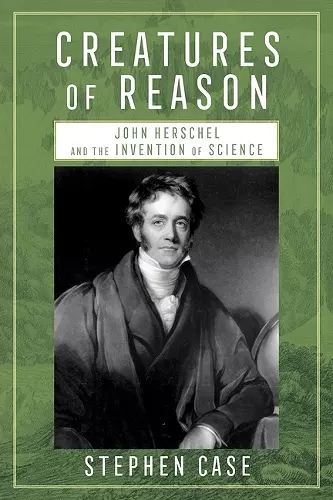
Explores the Early Life and Career of a Figure Central to the Development of Modern Scientific Practice
In his lifetime, John Herschel was Britain’s best-known natural philosopher, a world celebrity, and arguably the first modern scientist of the generation in which the term itself was invented. The polymath son of William Herschel, discoverer of Uranus and constructor of the world’s largest telescopes, Herschel took highest honors as a student at Cambridge, conducted groundbreaking work in chemistry and optics, helped establish a mathematical revolution, extended his father’s astronomical surveys to the entire sky, and wrote the popular texts by which a generation of readers learned what it meant to do science. Along the way, Herschel gave to natural philosophy the contours of modern science, defining scientific theories as “creatures of reason rather than of sense.” His creatures of reason could also refer to a new type of scientific practitioner: the natural philosopher beginning to transition into the modern scientist. With this book, Stephen Case encompasses Herschel’s impact on mathematics, chemistry, geology, and optics as well as the organization of science and its relation to government, society, and culture, revealing Herschel’s transformation of the practice of science itself. Drawing on his unpublished manuscripts, correspondence, and notebooks from archives in London, Cambridge, and Austin, this book contributes significantly to our understanding of the early life and career of the nineteenth century’s most influential natural philosopher.
Case’s approach to “the invention of science” is accessible, entertaining, and persuasive.
* Journal of British Studies *An admirable study of one man’s pursuit of scientific virtue and of the social, familial, and religious conditions that made such a pursuit possible. It is a welcome and timely contribution to the ongoing effort to recover the rich entanglements of reason, religion, and character in the history of science.
* H-Net Review *Rich in revealing and often amusing anecdotes, Stephen Case’s study of John Herschel is not just a first-rate biography but an invaluable analysis of nineteenth-century scientific culture. As Case ably demonstrates, Herschel was crucial to the transition of natural philosophy into what we now know as ‘modern science.’ This is a much-needed intervention into the history of science. In this deftly argued book, Case shows why Herschel matters to the complex relationship between society and science that dominates our world today.
-- Edward Gillin, University College LondonJohn Herschel’s Preliminary Discourse on the Study of Natural Philosophy (1830) was one of the most significant works in philosophy and science in the first half of the nineteenth century, setting the tone and guiding the aims of a generation of inquirers. This fully documented and clearly written book shows convincingly how Herschel’s earlier fascinations with travel and telescopes, with experiment and education, led to a remarkable exercise in reforming philosophy and scientific guidance. Stephen Case’s study gives the Preliminary Discourse and its author a central place in the forging of the principles and practice of the modern sciences.
-- Simon Schaffer, University of CambridgeIn approachable and occasionally sparkling prose, Case entices his readers to share in John Herschel’s passionate adventure in search of love, light, and a meaningful life of science. He has pulled tight the broad sweep of Herschel’s interests and tamed his ‘thickets of equations,’ successfully knitting mathematics and astronomy together with scientific politics and the writing of the Preliminary Discourse into a thoroughly enjoyable and enlightening tale of Herschel’s vision for modern science.
-- Kelley Wilder, De Montfort UniverISBN: 9780822948384
Dimensions: unknown
Weight: unknown
320 pages