The Language Movement in Bangladesh
Translingualism and a Struggle for Rhetorical Sovereignty
Format:Hardback
Publisher:University of Pittsburgh Press
Publishing:14th Jul '26
£96.95
This title is due to be published on 14th July, and will be despatched as soon as possible.
This hardback is available in another edition too:
- Paperback£32.95(9780822967903)
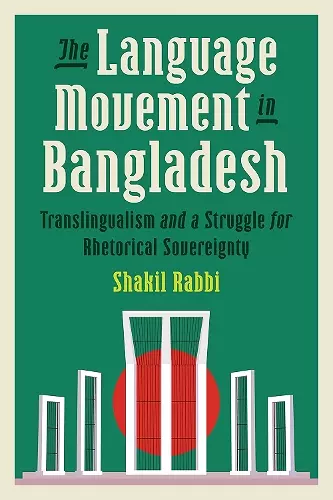
An Interdisciplinary Study of the Rhetorics of the Bangla Language Movement in Bangladesh
The Language Movement in Bangladesh charts the Bangla Language Movement from a rhetorical perspective. The Language Movement in Bangladesh adds to scholarship around language rights and language ideologies with an examination of a politically explosive debate in a non-Western and postcolonial context.
The Language Movement in Bangladesh charts the Bangla Language Movement from a rhetorical perspective. Following Partition in 1947, major conflicts over land, religion, power, and language characterized the newly independent nations of India and Pakistan. The debate over recognizing Bangla as a state language in East Pakistan was particularly consequential. Lasting nearly a decade, it upended Pakistan’s political and social order and set the stage for Bangladeshi independence in 1971. Shakil Rabbi investigates the rhetorical facets of this debate and its takeaways for critical conversations around translingualist perspectives and rhetorical sovereignty. Rabbi analyzes the role of traditional, modernist, and folk ideologies during this era of subcontinental history through a combination of digital humanities and translingualist methodologies. The Language Movement in Bangladesh adds to scholarship around language rights and language ideologies with an examination of a politically explosive debate in a non-Western and postcolonial context.
While translingualism is widely known for deconstructing monolithic ideologies and labeled languages, Shakil Rabbi demonstrates how fluid semiotic resources can help construct a national identity and ‘mother tongue’ for Bangladesh. This is a much-needed work on the ways translingualism can achieve rhetorical sovereignty for newly independent postcolonial communities in the Global South.
-- Suresh Canagarajah, Pennsylvania State UniversityA welcome contribution to conversations around translingualism and transnationalism in the field. Shakil Rabbi presents a refreshing range of archival materials and rich sociocultural perspectives to unpack the complex politics and ideologies of language and literacy in twentieth-century Bangladesh.
-- Nancy Bou Ayash, University of WashingtonShakil Rabbi’s meticulously researched exploration of the Bengali Language Movement bridges translingual and rhetorical frameworks, archival and digital humanities methodologies, Islamic rhetorics, and multiliterate rhetorical practices. In addition to emphasizing how translingual theory can be a productive framework for historical scholarship, Rabbi suggests new ways of understanding how language itself, as topoi, can index multiple spatiotemporalities in the struggle for rhetorical sovereignty.
-- Amber Engelson, Massachusetts College of Liberal ArtsThis book is a rare gift: a story of a language movement that succeeded, so much so that it led to UNESCO’s International Mother Language Day. By taking us inside the work of people who started, sustained, and died for the movement for the Bangla language, Shakil Rabbi shows readers that it is often some of the most precarious people—students, artists, workers—who end up changing the world.
-- Katherine Flowers, University of Massachusetts–LowellShakil Rabbi offers compelling insights into how translingual scholarship might be served by distant reading methods in order to limn the textual connectivities and dis-connectivities of discourse around Bangladesh’s historic Language Movement. His transverse methodology reflects a novel way of approaching rhetorical sovereignty within and between the geospaces that were formerly West and East Pakistan, through the framework of multiliteracies. More specifically, The Language Movement in Bangladesh reveals the significant semiotic, cultural, religious and political reaches of arguments for Bangla linguistic sovereignty, not only by implying how those arguments became entangled with a dozen other languages and their literatures between 1946 and 1956, but also by tracing their real-time occurrence across over a dozen genres, including generic events that have become more recently popularized throughout the Bangladeshi diaspora. In doing so, Rabbi resituates what had previously been historicized as a ‘state’ language debate within its broader global contexts.
-- Tarez Samra Graban, Florida State UniverISBN: 9780822949022
Dimensions: unknown
Weight: unknown
264 pages