Highland Indians and the State in Modern Ecuador
Marc Becker editor A Kim Clark editor
Format:Paperback
Publisher:University of Pittsburgh Press
Published:21st Nov '11
Should be back in stock very soon
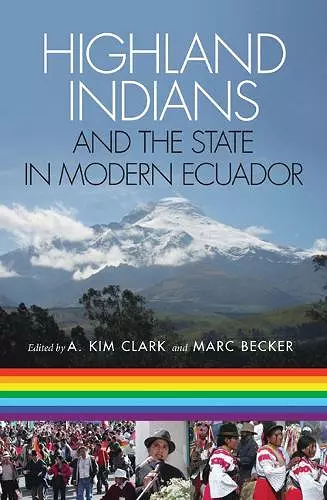
This volume chronicles the changing forms of indigenous engagement with the Ecuadorian state since the early nineteenth century that grew into the strongest unified indigenous movement in Latin America. Nine case studies examine how indigenous peoples have attempted to claim control over state formation in order to improve their position in society. It concludes with four comparative essays that place indigenous organizational strategies in Ecuador within a larger Latin American historical context.
Chronicles the changing forms of indigenous engagement with the Ecuadorian state since the early nineteenth century that grew into the strongest unified indigenous movement in Latin America. Nine case studies examine how indigenous peoples have attempted to claim control over state formation in order to improve their position in society.
Highland Indians and the State in Modern Ecuador chronicles the changing forms of indigenous engagement with the Ecuadorian state since the early nineteenth century that, by the beginning of the twenty-first century, had facilitated the growth of the strongest unified indigenous movement in Latin America.Built around nine case studies from nineteenth- and twentieth-century Ecuador, Highland Indians and the State in Modern Ecuador presents state formation as an uneven process, characterized by tensions and contradictions, in which Indians and other subalterns actively participated. It examines how indigenous peoples have attempted, sometimes successfully, to claim control over state formation in order to improve their relative position in society. The book concludes with four comparative essays that place indigenous organizational strategies in highland Ecuador within a larger Latin American historical context. Highland Indians and the State in Modern Ecuador offers an interdisciplinary approach to the study of state formation that will be of interest to a broad range of scholars who study how subordinate groups participate in and contest state formation.
An outstanding contribution . . . the most comprehensive and authoritative text available on the historical development and contemporary implications of Ecuador's fascinating indigenous social movement.
* Journal of Latin American Studies *Excellent. This will become the standard work on the origins of the Ecuadorian indigenous movement-there is nothing like it on the market. This is the book on Ecuador that all libraries will need to get.
* Erick D. Langer, Georgetown University *Succeeds on many levels. Any serious comparative inquiry into Latin America's indigenous movements would be well served by this title. Ecuadorianist scholars concerned about politics, native peoples and the modern history of the nation will find this voume indispensable.
* A Contra corriente *Theoretically sophisticated yet highly accessible . . . helps us understand perhaps the region's most successful indigenous movement within its historical and comparative context. It does this better than any other book currently available. Along the way, it offers a history of modern Ecuador that is compelling and a treatment of state formation that should be read by anyone interested in understanding postindependence in Latin America.
* Hispanic American Historical Review *This book fills a significant gap in the scholarly literature on state formation in postindependence Latin America. The contributors do an excellent job of bringing Ecuador directly into broader debates and discussions about Latin America as a whole. The volume will also compel scholars who work elsewhere in Latin American to reassess their work in light of the important findings presented here.
* David Nugent, Emory University *This book, creatively straddling history and anthropology, deftly locates the recent upsurge of indigenous political mobilization in a richly varied, theoretically informed, long-term historical context. It offers a marvelous menu of ethnographies of the state (and processes of state formation from below) that hew to the volume's central analytical focus-namely, the conflictive negotiations through which local indigenous peoples tried to project their interests, identities, and ideas into the larger political arena. This volume is an essential contribution to Latin American indigenous and social movements, as well as to the comparative history of peasants and modern state formation.
* Brooke Larson, author of Trials of Nation Making: Liberalism, Race, and Ethnicity in the Andes, 1810-1910.ISBN: 9780822961468
Dimensions: unknown
Weight: unknown
360 pages