Elusive Equality
Gender, Citizenship, and the Limits of Democracy in Czechoslovokia, 1918-1950
Format:Paperback
Publisher:University of Pittsburgh Press
Published:20th Apr '06
Should be back in stock very soon
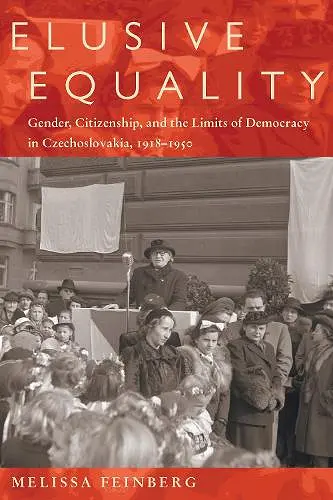
Examines debates over women's rights in the first half of the twentieth century, to show how Czechs gradually turned away from democracy and established the separation of state and domestic issues, at the expense of personal freedoms.
When Czechoslovakia became independent in 1918, Czechs embraced democracy, which they saw as particularly suited to their national interests. Politicians enthusiastically supported a constitution that proclaimed all citizens, women as well as men, legally equal. But they soon found themselves split over how to implement this pledge. Some believed democracy required extensive egalitarian legislation. Others contended that any commitment to equality had to bow before other social interests, such as preserving the traditional family.
On the eve of World War II, Czech leaders jettisoned the young republic for an “authoritarian democracy” that firmly placed their nation, and not the individual citizen, at the center of politics. In 1948, they turned to a Communist-led “people's democracy,” which also devalued individual rights.
By examining specific policy issues, including marriage and family law, civil service regulations, citizenship law, and abortion statutes, Elusive Equality demonstrates the relationship between Czechs' ideas about gender roles and their attitudes toward democracy. Gradually, many Czechs became convinced that protecting a traditionally gendered family ideal was more important to their national survival than adhering to constitutionally prescribed standards of equal citizenship. Through extensive original research, Melissa Feinberg assembles a compelling account of how early Czech progress in women's rights, tied to democratic reforms, eventually lost momentum in the face of political transformations and the separation of state and domestic issues. Moreover, Feinberg presents a prism through which our understanding of twentieth-century democracy is deepened, and a cautionary tale for all those who want to make democratic governments work.
Melissa Feinberg cogently analyzes conflicts over the meaning of women's citizenship in Czechoslovakia, arguing that the issue of gender equality was central to Czech politics during the interwar period and immediately after. This well-researched volume fills a lacuna in the historiography of the country, indeed, of the region.
* Nancy M. Wingfield, Northern Illinois University *In rendering women's citizenship the test case for Czech democracy, Feinberg succeeds in gendering both Czech national history and the history of citizenship more broadly. Her arguments about Czech democracy offer compelling lessons for scholars of gender and citizenship in other republican or democratic settings.
* Kathleen Canning, University of Michigan *Elusive Equality successfully integrates fresh research with some of the most sophisticated current findings on gender history in modern Europe. Feinberg offers solid evidence for rethinking the place of gender in our concepts of democracy, and especially of citizenship. She brings to light entirely new aspects of the history of Czechoslovakia during the first half of the twentieth century.
* Maria Bucur, Indiana University *[A] must-read. Feinberg's well-told cautionary tale serves as a reminder to readers and reformers everywhere that liberty for women and men is always in question and in danger.
* Feminist Review *Feinberg possesses a deep sensitivity to the nuances of the issues at stake, presents them clearly, and points out the inconsistencies in the arguments raised by the feminists' opponents. Meticulously researched and compelling.
* Slavic Review *Feinberg's approach . . . is refreshing. The book's contribution lies in connecting debates about citizenship and democracy with a detailed analysis of struggles over gender equality in the emerging Czechoslovak political system.
* Czech Sociological ReviewISBN: 9780822961970
Dimensions: unknown
Weight: unknown
288 pages