Voices of Change in Cuba from the Non-State Sector
Format:Paperback
Publisher:University of Pittsburgh Press
Published:17th Apr '18
Should be back in stock very soon
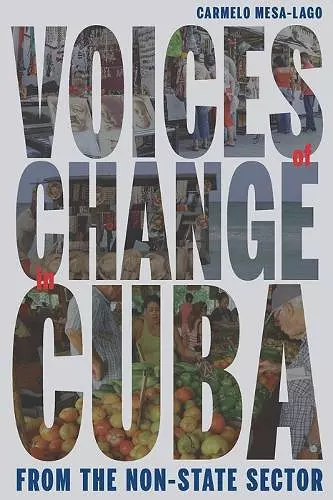
More than one million Cubans, representing thirty percent of the country's labor force, currently comprise the non-state sector. This development represents a crucial structural reform implemented by Raul Castro. Yet, little has been published about the demographic makeup of this group. Based on eighty in-depth interviews recently conducted in Cuba, this book offers fascinating insights into today's Cuban economy from the non-state sector, while also reflecting on its potential for development and the obstacles it faces.
More than one million Cubans, representing thirty percent of the country's labor force, currently make up the nonstate sector. This development represents a crucial structural reform implemented by Raúl Castro since becoming Cuba's leader in 2006, and may become the most dynamic economic force for the country's future.
More than one million Cubans, representing thirty percent of the country's labor force, currently make up the nonstate sector. These include self-employed workers and micro-entrepreneurs, sharecropping farmers, members of new cooperatives, and buyers and sellers of private dwellings. This development represents a crucial structural reform implemented by Raúl Castro since becoming Cuba's leader in 2006, and may become the most dynamic economic force for the country's future. Despite this phenomenon, little has been published about the demographic makeup of this group (age, gender, race, and education), as well as their economic conditions and aspirations. Based on eighty in-depth interviews recently conducted in Cuba, this book captures actual voices from this evolving economic sector. It details workers' level of satisfaction with what they do and earn, profits (and how they are allocated between consumption and investment), plans to expand their activities, receiving foreign remittances and microcredit, competition, forms of advertising, and payment of taxes. Perhaps most revealing are the speakers' views on the obstacles they face and their desires for change and improvement. As such, the book offers fascinating insights into today's Cuban economy from the nonstate sector, while also reflecting on its potential for development and the obstacles it faces.
The most comprehensive and well-thought-out account of Cuba's new private sector. This book presents a wealth of information that had never before been compiled so systematically.
* Jorge I. Dominguez, Harvard University *One of the most significant contributions to the economic and social history of Cuba.
* Consuelo Naranjo Orovio, Consejo Superior de Investigaciones Cientificas *A unique treasure. A triumph of scholarship in a country where fieldwork is notoriously difficult to carry out.
* Mitchell A. Seligson, Vanderbilt University *For its scholarly rigor, immense readability and policy-making applications, this is a pioneering volume. It takes a 'ground-up' approach relying on interviews with Cubans that speak for themselves.
* Lillian Guerra, University of FloriISBN: 9780822965091
Dimensions: unknown
Weight: unknown
176 pages