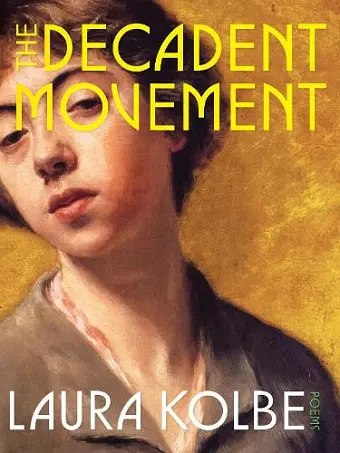
The Decadent Movement
Poems
Format:Paperback
Publisher:University of Pittsburgh Press
Published:22nd Sep '26
Should be back in stock very soon
A Reverse-Diary in Poems that Chronicles the First Year of Motherhood and Nine Months of Pregnancy, from End to Beginning
A "visceral, musical, and tender" collection (The New Yorker)
The Decadent Movement is a book-length suite of poems that spins backward in time through the early days of parenthood and the preceding nine months of pregnancy. From the opening poem “Afterword,” each dated poem slides backward in time, with the poem “Hinge” at the manuscript’s midpoint spoken from the moment of childbirth.
The Decadent Movement is a book-length suite of poems that spins backward in time through the early days of parenthood and the preceding nine months of pregnancy. Beginning a year after childbirth in the harried throes of marriage and parenting, the collection proceeds toward its finale “Minus Time,” which marvels at death’s near-identical twin – that infinite period of nonexistence that precedes each new life. From the opening poem “Afterword,” each dated poem slides backward in time, with the poem “Hinge” at the manuscript’s midpoint spoken from the moment of childbirth.
This unraveling of a predicament by playing it in reverse – “Muybridged / out so anyone could see, framed, a woman / running for her life” – allows for rigorously honest accounting of mixed feelings about motherhood and its accompanying physical and psychic changes, detached from the readymade tropes of the “pregnancy plot.”
The Decadent Movement is a book about the fear of loss (of sexual personhood, bodily self-determination, the ability to write, and the license to be headlong and volatile). Yet it is also about the need to insist on new terms of engagement with those we love, new languages of willfulness and desire.
This “diary in poems” documents, in reverse chronological order, the nine months of the speaker’s pregnancy and her first year of motherhood—what the book’s opening entry describes as “a span of life ranged with newish / mountains,” and pledges “not to smooth or numb.” Kolbe’s distinctive use of language brings to life this period’s wonders and difficulties, and her maximalist approach to metaphor creates many energetic images. Though visceral, musical, and tender, the collection takes a cerebral, almost scientific attitude toward maternity (the author is also a physician)—not by drawing a clinical distance but by treating it as something to be observed from every possible angle.
* The New Yorker *In The Decadent Movement, [Kolbe] plumbs the depths of motherhood: a worthy subject for her substantial talents.
* LitHub’s Most Anticipated Books of 2026 *Decadent in acoustics, refined in argumentation, Kolbe’s second book merits serious consideration for the year’s biggest prizes and fellowships. It is a book that excites me about what poetry can achieve and where the art is going, and it is a book that treats motherhood, along with its attendant ambivalences, with the massiveness and multidimensionality that the experience deserves.
* Preposition Mag *The Decadent Movement pulls the reader into exhilaration and transfiguration, but denies absolute telling (if such a thing is possible in a poem). These poems pierce inherited fears and tropes around femininity and motherhood that attempt to settle on the speaker for too long, yet maintain care towards all her beloveds as she swirls between states, responsibilities, and loves.
* Delicatessen *The poems of Laura Kolbe do more than just continue the noble tradition of physician-poets; in The Decadent Movement they redefine the relations between body and body, mind and mind, mother and child. The book’s astonishing final poem is an apostrophe to the not-yet-existent that ‘cannot be studied or moved’ but can be talked to. What bodies can do, and must do, is anticipate lovingly.
-- Bin Ramke, author of Earth on EarthThe intricate, barreling, and multifarious poems in The Decadent Movement explore the fraught situation of motherhood with tremendous excitement and frankness. Here is maternity as dilemma and possibility, a cluster of grand yearnings and workaday hazards. The desire to maintain a distinct, inner world comes up against separation as cosmic lostness; and yet, merger is engulfment as well as paradise. All the way through, Laura Kolbe’s self-consciousness about transformation keeps things bracingly restless, playful even, full of pleasure-pain.
-- Sandra Lim, author of The Curious ThingIt is a rare privilege to be inside the mind of this poet as she unspools the chronicle, told in reverse, of the arduous, hallucinatory, and utterly mortal time of pregnancy and early parenthood. With her, we experience the shock of what happens to a body, a marriage, an artist’s mind, as she becomes a mother. These poems are beautiful, intelligent, honest, funny, conflicted, hopeful, and real, and tell us the oldest story in a new and necessary way.
-- Matthew Zapruder, author of I Love Hearing Your Dreams and Story of a PoemLaura Kolbe’s sonic, wordsmithy poems are granular and cosmic, traveling that edge where inner and outer space meet, where these poems spill like milk off the page, strange, sticky, fluid, flowing, alive. In this realm, maternal reality is lived, living, imminent and insistent, and repeating, echoing, lapping, lapsing, collapsing, collecting. Here, the poet’s mind makes real a mother’s life—so often fragmented—meeting chaos with textured, visceral lines that furnish a world, tend a family, and inscribe a full self in full bloom.
-- Brenda Shaughnessy, author of TISBN: 9780822968368
Dimensions: unknown
Weight: unknown
128 pages