Gender and Nation in the Spanish Modernist Novel
Format:Hardback
Publisher:Vanderbilt University Press
Published:30th Dec '03
Should be back in stock very soon
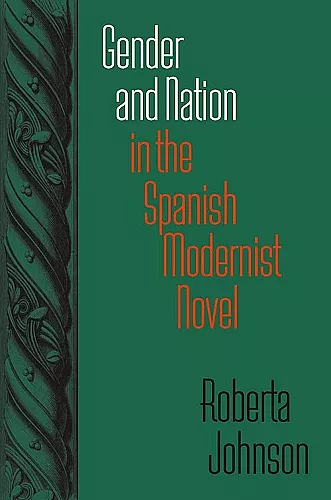
Offering a fresh, revisionist analysis of Spanish fiction from 1900 to 1940, this study examines the work of both men and women writers and how they practiced differing forms of modernism. As Roberta Johnson notes, Spanish male novelists emphasized technical and verbal innovation in representing the contents of an individual consciousness and thus were more modernist in the usual understanding of the term. Female writers, on the other hand, were less aesthetically innovative but engaged in a social modernism that focused on domestic issues, gender roles, and relations between the sexes. Compared to the more conventional--even reactionary--ways their male counterparts treated such matters, Spanish women's fiction in the first half of the twentieth century was often revolutionary.
The book begins by tracing the history of public discourse on gender from the 1890s through the 1930s, a discourse that included the rise of feminism. Each chapter then analyzes works by female and male novelists that address key issues related to gender and nationalism: the concept of intrahistoria, or an essential Spanish soul; modernist uses of figures from the Spanish literary tradition, notably Don Quixote and Don Juan; biological theories of gender prevalent in the 1920s and 1930s; and the growth of an organized feminist movement that coincided with the burgeoning Republican movement.
This is the first book dealing with this period of Spanish literature to consider women novelists, such as Maria Martinez Sierra, Carmen de Burgos, and Concha Espina, alongside canonical male novelists, including Miguel de Unamuno, Ramon del Valle-Inclan, and Pio Baroja. With its contrasting conceptions of modernism, Johnson's work provides a compelling new model for bridging the gender divide in the study of Spanish fiction.
Roberta Johnson's new study is a major undertaking based on a mature scholar's decades-long investment in the thought and cultural flow of the days of the vanguard. An enterprise significant for its topic and impressive for its execution, it boasts expansive research, thorough historical grounding, and detailed textual analyses.
--Journal of Hispanic Cultural Studies
Roberta Johnson's new study is a major undertaking based on a mature scholar's decades-long investment in the thought and cultural flow of the days of the vanguard. An enterprise significant for its topic and impressive for its execution, it boasts expansive research, thorough historical grounding, and detailed textual analyses.
--Journal of Hispanic Cultural Studies
[A] fresh and exciting look at the Spanish novel from the Generation of 1898 to the onset of the civil war in 1936.
--Virginia Quarterly Review
[A] fresh and exciting look at the Spanish novel from the Generation of 1898 to the onset of the civil war in 1936.
--Virginia Quarterly Review
This is a major contribution to modern peninsular studies. Regardless of discipline, the two issues perhaps of greatest importance to cultural and literary studies at this moment (gender and national identity) are precisely the topics Johnson is bold enough to grapple with vis-a-vis Spain at a crucial period of its history. Slippery concepts such as modernism, feminism, nation, vanguardism are discussed in ways that question our previous understandings of them.
--Michael Ugarte
This is a major contribution to modern peninsular studies. Regardless of discipline, the two issues perhaps of greatest importance to cultural and literary studies at this moment (gender and national identity) are precisely the topics Johnson is bold enough to grapple with vis-a-vis Spain at a crucial period of its history. Slippery concepts such as modernism, feminism, nation, vanguardism are discussed in ways that question our previous understandings of them.
--Michael Ugarte
A provocative and compelling rethinking of Spanish Modernism through the lens of gender. Written with Johnson's customary insight, rigor, and elan, Gender and Nation tracks the intertextual crossfire as male and female authors debate women's place in the future of Spain. This is an illuminating study grounded in wide-ranging research. A must read for anyone interested in modern Spain.
--Maryellen Bieder
A provocative and compelling rethinking of Spanish Modernism through the lens of gender. Written with Johnson's customary insight, rigor, and elan, Gender and Nation tracks the intertextual crossfire as male and female authors debate women's place in the future of Spain. This is an illuminating study grounded in wide-ranging research. A must read for anyone interested in modern Spain.
--Maryellen Bieder
ISBN: 9780826514363
Dimensions: unknown
Weight: unknown
368 pages