Health in the Marketplace
Professionalism, Therapeutic Desires, and Medical Commodification in Late-Victorian London
Format:Hardback
Publisher:Society for the Promotion of Science & Scholarship Inc.,U.S.
Published:10th Sep '10
Should be back in stock very soon
Well before the efflorescence of late-Victorian commodity culture, medical capitalism had permeated-and in many ways compromised-the seemingly well-established purity of medical professionalism. -- Timothy Lenoir, Duke University This work bursts with fine research, excellent ideas, and a superb topic. The book charts the tensions, affiliations, and conflicts between engineers, advertisers, manufacturers of patent medicines, medical doctors, and consumers of health-related services and goods. It illuminates major concerns and issues in contemporary medicine and society. -- Seth Koven, Rutgers University
Demonstrates that Victorians confronted issues of medical and quasi-medical claims and counter-claims in much the same way as we do
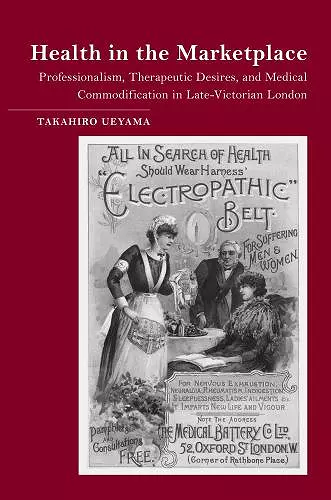
Much like consumers today, late-19th-century Londoners lived in a mass culture of commodified abundance and conspicuous consumption. Their consumer fetishism was fully represented by their avid pursuit of health-related services and medicinal goods--the market was rife with brand-name patent medicines such as Dr. Scott's Little Liver Pills and Dr. William's Pink Pills for Pale People, and city-dwellers frequently bought patented medico-electrical appliances such as Pulvermacher's Electric Chains or Harness' Electropathic Belt.
In this highly original book Takahiro Ueyama recounts a vivid narrative--populated by long-forgotten entrepreneurs and charlatans--that accounts for the way in which socioeconomic and professional interests came into conflict among medically trained doctors, electrical engineers, manufacturers of patent medicines, and quack physicians.
Thoroughly grounded in research into health commodification in the late 19th century, this book demonstrates that Victorians had issues very much like ours today. Like us, they wrestled with ambiguities about drug effectiveness and regulation. Like us, they worried about the uncertain boundaries between science and quackery. They, too, were baffled by the competing claims of orthodox and alternative medicine. They, too, went in for massage therapy and erotic quasi-medical services. Such was reality in late-19th-century Britain, and it was the root of what we observe in our highly capitalized modern world, where profit-driven commercialism ubiquitously intrudes into the medical domain.
"Well before the efflorescence of late-Victorian commodity culture, medical capitalism had permeated--and in many ways compromised--the seemingly well-established purity of medical professionalism." Timothy Lenoir, Duke University
ISBN: 9780930664299
Dimensions: unknown
Weight: 680g
378 pages