Kant's Critique of Pure Reason and the Method of Metaphysics
Format:Hardback
Publisher:Cambridge University Press
Published:25th May '23
Currently unavailable, and unfortunately no date known when it will be back
This hardback is available in another edition too:
- Paperback£24.99(9781009172110)
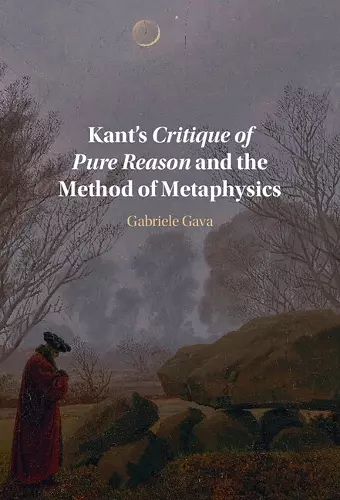
This book sheds light on Kant's claim that the Critique of Pure Reason is a 'treatise' or 'doctrine' of method.
In two often neglected passages of the Critique of Pure Reason, Kant submits that the Critique is a 'treatise' or a 'doctrine of method'. Gabriele Gava argues that these passages point out that the Critique is the doctrine of method of metaphysics, with the task of showing that metaphysics can become a science.In two often neglected passages of the Critique of Pure Reason, Kant submits that the Critique is a 'treatise' or a 'doctrine of method'. These passages are puzzling because the Critique is only cursorily concerned with identifying adequate procedures of argument for philosophy. In this book, Gabriele Gava argues that these passages point out that the Critique is the doctrine of method of metaphysics. Doctrines of method have the task of showing that a given science is indeed a science because it possesses 'architectonic unity' – which happens when it realizes the 'idea' of a science. According to Gava's novel approach, the Critique establishes that metaphysics is capable of this unity, and his reading of the Critique from this perspective not only illuminates the central role of the Transcendental Doctrine of Method within it, but also clarifies the relationship between the different parts of the work.
'This is an interesting, ambitious and hugely impressive work that concerns the crucial and under-explored question of the methodology at play in Kant's Critique of Pure Reason. Gava's careful and extensive analysis puts the relationship between Kant's notions of 'transcendental philosophy' and a 'critique of pure reason' in a new light, one that will be of interest to anyone working on Kant's metaphysics and epistemology today.' John Callanan, King's College London
'Throughout the book, Gava consistently asks and answers important questions about where in the Critique Kant takes on certain tasks, and how doing so serves Kant's overarching aim of establishing that metaphysics can become architectonic. Gava's detailed attention to the organization of the text, befitting of Kant's broadly scholastic roots, is often enlightening. What emerges is a compelling, coherent, and comprehensive account of the aims and composition of the entire Critique.' Charles Goldhaber, Journal of Transcendental Philosophy
'One of the great assets of Gabriele Gava's Kant's Critique of Pure Reason and the Method of Metaphysics is that it foregrounds a set of questions that stem directly from the Critique itself yet have attracted remarkably little attention. Rather than offering detailed accounts of much-debated issues such as Kant's idealism, realism, conceptualism, and the thing in itself, Gava focuses on the question as to why Kant proceeded the way he did and, more specifically, on the role of the Critiquein its capacity as doctrine of method of metaphysics. In so doing, Gava rightly gives pride of place to metaphilosophical concerns that most interpretations tend to marginalize. His monograph offers a holistic interpretation that presents core aspects of the Critique in a new light. Moreover, he rightly shifts the focus of attention from Kant's investigation into the a priori elements of experience to the question as to how metaphysics can be developed in a scientific manner.' Karin de Boer, Kantian Review
'I found Gava's book a thoughtful work that raises issues of interest to any reader of the Critique. The book is certainly not aimed specifically at students, and some of it will be challenging for those early in their study of Kant's work, but its account of the different stages of Kant's argument in the Critique will be helpful to them, particularly if its full implications are brought out by their teachers in the way that I have suggested. So this book is a welcome addition to the literature on the Critique of Pure Reason.' Paul Guyer, Studi Kantiani
'It is a work of excellent scholarship, clearly and persuasively presented. It has intelligent and original things to say about many of the central puzzles across the different parts of the CPR, as well as about the implications of that work for Kant's wider systematic philosophy. I think that anyone with a serious interest in Kant's philosophy should read it.' Robb Dunphy, International Journal of Philosophical Studies
'Gava's work is admirable in its lucidity, scope, and mastery of primary and secondary sources.' Joe Stratmann, Journal of the History of Philosophy
'Gava's Kant's Critique of Pure Reason and the Method of Metaphysics is a valuable contribution to the already vast body of literature on the first Critique. … regardless of whether one ultimately agrees with the details of his reading, Gava's central question of how each part and section of the Critique contributes to its ultimate aim of making metaphysics a science is an important one to bear in mind for any reader of the Critique. This book is a must-read for anyone working on the Critique, and I am sure it will serve as a valuable resource for generations of Kantians to come.' Lewis Wang, British Journal for the History of Philosophy
'Gava's book is excellent. Taking seriously Kant's central yet often neglected claim that the Critique of Pure Reason is a treatise on method allows him to reaffirm its primarily methodological nature and to interpret systematically its several sections and topics as belonging to the unitary fundamental issue of method, thereby filling a significant gap in secondary literature.' David Del Bianco, Con-Textos Kantianos
'Gava's book presents an ambitious and illuminating interpretation of the critique of pure reason as a doctrine of method for metaphysics. While I remain unconvinced that this interpretation fully captures the critique's nature-which must, by its constitution, also demonstrate the possibility of metaphysical knowledge-I'm in no doubt that the book makes a significant contribution to current debates on Kant's metametaphysics. I recommend it to anyone working on Kant's account of critique and its relation to transcendental philosophy. The book is clearly written, carefully argued, textually attentive, and rich in insight, both in detail and in scope.' Christopher Benzenberg, European Journal of Philosophy
'The book offers an original reorientation to many well-trodden debates about the first Critique, carried out through a detailed yet clear reconstruction and evaluation of Kant's arguments. This makes the book an invaluable contribution, and I highly recommend it to anyone interested in the Critique of Pure Reason.' Noam Hoffer, Kantian Review
ISBN: 9781009172103
Dimensions: 235mm x 158mm x 21mm
Weight: 570g
300 pages