Comparing Syntax
An Introduction to Formal Language Typology
Format:Paperback
Publisher:Cambridge University Press
Published:9th Jul '26
Should be back in stock very soon
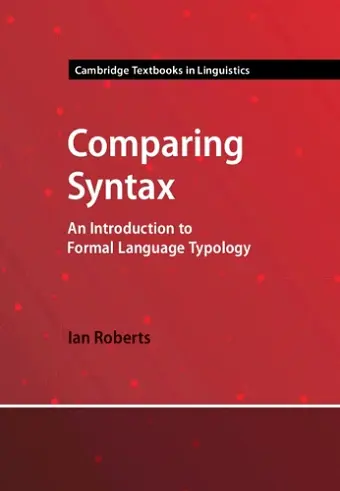
A thorough introduction to formal syntactic typology, Comparing Syntax systematically covers syntactic variation across languages.
A thorough introduction to formal syntactic typology, which covers syntactic variation across languages. The comprehensive glossary, end-of-chapter exercises and annotated further reading lists allow readers to consolidate and extend their knowledge as they progress through the book. Ideal for intermediate and advanced-level students of syntax.A thorough introduction to formal syntactic typology by a leader in the field, Comparing Syntax systematically covers syntactic variation across languages. The textbook covers word-order parameters, null subjects, polysynthesis, verb-movement, ergativity, interrogatives and negation within a comparative framework, ensuring that readers are able to engage with the key topics in the most up-to-date primary research literature. The comprehensive glossary, end-of-chapter exercises and annotated further reading lists allow readers to consolidate and extend their knowledge as they progress through the book. A self-contained work ideal for intermediate and advanced-level students, Comparing Syntax also builds on the author's Beginning Syntax and Continuing Syntax.
'This excellent third volume of Roberts' syntax trilogy introduces students to generative theories of linguistic typology: why does the grammar of languages vary in just the way it does? The book expertly explains fundamental concepts, generalisations, and phenomena. Novel problem sets, end-of-chapter reading lists, and a glossary make it uniquely helpful to intermediate and advanced syntax students.' David Adger, Queen Mary University London
'With its distinctive coverage of language typology, Comparing Syntax is a fitting conclusion to the three-volume series and an excellent stand-alone for advanced readers. It situates current work in typology within the broader historical context and highlights practical considerations, equipping students to undertake their own research. A timely, much needed resource.' Anna Grabovac, University of Pennsylvania
'A brilliantly crafted, theory-rich textbook that vividly shows how syntax and typology inform each other. Guiding students through a fascinating journey across diverse languages and linguistic phenomena, it uncovers the principles behind patterned variation. It's clear, insightful, and engaging: a major contribution that deepens our understanding of how and why languages differ.' Hedde Zeijlstra, University of Göttingen
'A masterful, compelling, up-to-date, and pedagogical treatise of comparative syntax. As usual, Roberts carefully and systematically reviews key topics in syntactic theorising in a reader-friendly fashion. At the same time, he offers us a host of empirical arguments from countless linguistic varieties alongside useful, challenging, and engaging end-of-chapter exercises. Definitely a must-read for anybody interested in formal syntactic typology.' Julio Villa-Garcia, University of Ovideo and University of Manchester
'A book like this is long overdue. Students will benefit immensely from a textbook that brings together two disciplines that, until recently, were considered almost irreconcilable: formal syntax and linguistic typology. It is perhaps only through the study of the wealth of linguistic phenomena that anyone can truly appreciate the explanatory power of generative syntax.' Christina Sevdali, Ulster University
'Comparing Syntax is a truly excellent text on syntactic typology with clear explanations and illustrative data. The text introduces and covers critical topics in syntax, morphology and typology rarely covered in introductory texts. A valuable and essential resource for the classroom and beyond.' Jeffrey Punske, Southern Illinois University
'An excellent synthesis of formal syntax and typological inquiry, combining rigorous cross-linguistic analysis with clear theoretical grounding. Bringing together theoretical insight and rich empirical data, this textbook illuminates how languages vary and what those variations reveal about the nature of human grammar, providing a solid foundation for readers engaging with contemporary syntactic research.' Andrew Hedding, University of Washington
ISBN: 9781009291606
Dimensions: unknown
Weight: 250g
248 pages