Hot Spots of Crime
Social Structure and Social Context at the Micro Geographic Level
David Weisburd author Clair V Uding author Beidi Dong author Kiseong Kuen author
Format:Paperback
Publisher:Cambridge University Press
Published:30th Jul '26
Currently unavailable, and unfortunately no date known when it will be back
This paperback is available in another edition too:
- Hardback£80.00(9781009352826)
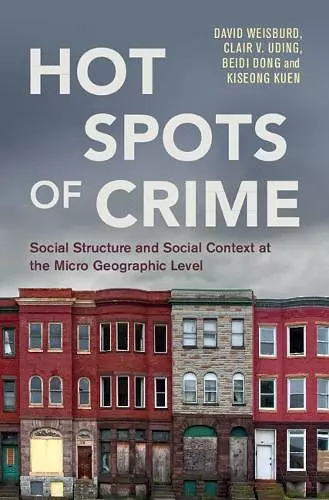
This non-fiction paperback, "Hot Spots of Crime" from David Weisburd, Clair V Uding, Beidi Dong & Kiseong Kuen, was published 30th July 2026 by Cambridge University Press.
'David Weisburd has been at the forefront of a revolution in the way we understand crime. This book written with colleagues is an elegant and persuasive account of the importance of understanding hot spots of crime. When it comes to crime, we have been focused on people. It is time, they argue, that we also focus on place.' Malcolm Gladwell, author of Revenge of the Tipping Point: Overstories, Superspreaders, and the Rise of Social Engineering
'David Weisburd and colleagues marry big data with big ideas to achieve a contemporary criminological classic. Addressing the daunting challenge of the sources of crime concentration, they show that 'hot spots' and 'cold spots' are produced not only by opportunity but also by structural and contextual factors. These findings are a turning point in theoretical criminology and of immense practical significance, making a compelling case that urban crime prevention must focus simultaneously on policing and on the health and social well-being of residents. A true masterpiece!' Francis T. Cullen, Distinguished Research Professor Emeritus, University of Cincinnati
'David Weisburd has been a leader in research demonstrating that 'hot spots' of crime are highly concentrated in microgeographic places. In this book, he and his colleagues address a new challenge: the social structure and organization of these places. Drawing on community-level theory and a unique study of Baltimore, they show that informal social control is a key mechanism through which crime concentrates at hot spots. This is a novel insight, as is the finding that social, but not physical, disorder matters for the concentration of crime. Creatively bridging the communities and place literatures, which are often separated, Hot Spots of Crime has important implications for criminological theory and policy.' Robert J. Sampson, Harvard University and author of Great American City: Chicago and the Enduring Neighborhood Effect
ISBN: 9781009352833
Dimensions: unknown
Weight: 366g
270 pages