Incomplete Constitutions and Coordination in Deeply Divided Societies
The Afghan Experiment
Format:Paperback
Publisher:Cambridge University Press
Publishing:31st Dec '26
£38.00
This title is due to be published on 31st December, and will be despatched as soon as possible.
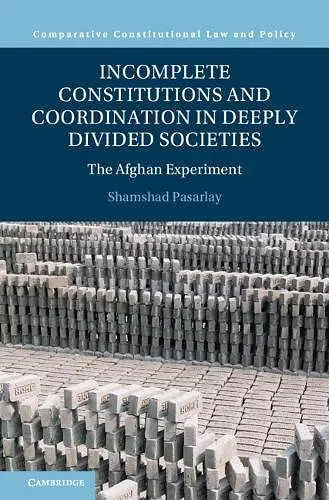
Helps readers understand why some deeply divided societies have managed to craft stable constitutional regimes while others have failed.
This book is directed at scholars who wish to understand the riddles of constitutional performance and endurance in deeply divided societies, and those who are interested in understanding Afghanistan's troubled constitutional history, specifically the rise and fall of the country's 2004 Constitution.Why are some deeply divided societies able to craft stable constitutional regimes while others have failed and continue to be mired in endless communal conflict? This puzzle constitutes the central question this book seeks to address. This book is directed at scholars who wish to understand the riddles of constitutional performance in deeply divided societies, and those who are interested in understanding Afghanistan's troubled constitutional history. By providing the most comprehensive account of the drafting and performance of Afghanistan's 2004 constitution, the book is aimed at scholars who want to understand the nuances of the process that produced the Constitution and evaluate its performance with fresh eyes. The world is full of divided, post-conflict societies which continue to witness tragic violent conflicts. This book is thus a valuable resource for policy makers who are currently grappling with how to approach thorny problems of constitutional design and nation-building in these societies.
'This book provides a compelling account of Afghanistan's constitutional history and advances an innovative model of coordination through deliberately incomplete constitutions in deeply divided societies. Combining deep expertise in Afghan constitutionalism with comparative constitutional insights, Shamshad Pasarlay offers a readable, persuasive, and thought-provoking framework of wide relevance. I recommend it highly.' Cheryl Saunders, Professor of Law at the Melbourne Law School
'This extraordinary book provides us with the most detailed and informative account to date of Afghanistan's surprisingly rich constitutional history. It demonstrates that the people who drafted Afghanistan's constitutions over the years thought deeply about the governance challenges facing states with populations that are divided along tribal, linguistic and religious lines. Describing different Afghan constitutions and exploring their different levels of success, Dr. Pasarlay convincingly challenges contemporary wisdom about constitutional process and constitutional design. He proposes a new approach to creating constitutions that can promote stable, responsive, popularly legitimate government in a communally divided society. This book will be of great interest to historians, political scientists, legal academics and policy makers.' Clark B. Lombardi, Dan Fenno Henderson Professor of Law, University of Washington School of Law
'Professor Shamshad Pasarlay has drawn on an extensive range of existing and untapped archives, and blended the fruit of that work with a sophisticated analytic model of constitutional stability. The resulting work excels by offering not just a definitive constitutional history of Afghanistan, but a fresh and thought provoking argument about how legal order can emerge from social diversity and conflict. This is much needed work, not just for Afghanistan given its parlous state, but for comparative constitutional scholars more generally. It could not be more timely or necessary.' Aziz Huq, Frank and Bernice J. Greenberg Professor of Law, The University of Chicago
ISBN: 9781009390507
Dimensions: unknown
Weight: unknown
235 pages