Celestial Mechanics
Classical and Modern Methods
Antonio Giorgilli author Marco Sansottera author Ugo Locatelli author
Format:Paperback
Publisher:Cambridge University Press
Published:16th Jul '26
Currently unavailable, and unfortunately no date known when it will be back
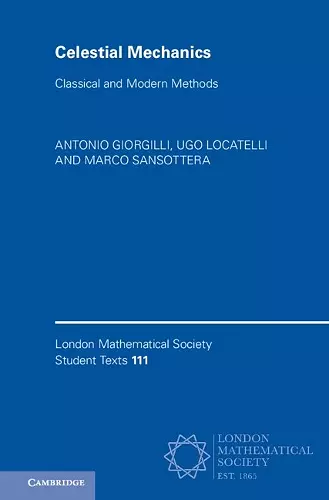
This non-fiction paperback, "Celestial Mechanics" from Antonio Giorgilli, Marco Sansottera & Ugo Locatelli, was published 16th July 2026 by Cambridge University Press.
'This book on Celestial Mechanics remarkably integrates theoretical analysis, historical context, and modern computational methods. The subjects addressed span from Kepler's laws to the stability of planetary systems. It constitutes an indispensable resource for students and researchers involved in the fields of Celestial Mechanics and Dynamical Systems.' Alessandra Celletti, Department of Mathematics, University of Rome Tor Vergata
'Reflecting the school of thought sculpted over the years by the senior author and two of his beloved scientific children, this book offers a step-by-step historical approach to the development of virtually all central concepts of utility in modern celestial mechanics and canonical perturbation theory, accompanied by some of the authors' well-known contributions. The text balances rightly between mathematical rigor and conceptual clarity, and it is highly recommended both as textbook or reference for advanced researchers in the field.' Christos Efthymiopoulos, University of Padua, Italy
'Celestial Mechanics: Classical and Modern Methods is written by world leaders in celestial mechanics and is a joy to read. It combines state of the art mathematical methods in their application to some of the most famous problems in celestial mechanics such as the Three-Body Problem or the stability of the solar system. This book is very special in linking the modern view of celestial mechanics into a historical perspective that is developed much beyond what is usually seen.' Jacques Laskar, Paris Observatory
'This is a true space opera of celestial mechanics - from the ancients to the present day. The vivid narrative moves seamlessly from classical to contemporary methods, complementing the mathematical developments with a rich historical perspective. Its central theme is the timeless problem of the stability of planetary motion - a challenge to which the greatest minds - Newton, Poincaré, Kolmogorov, Arnold, among others - have made brilliant contributions. The authors themselves continue this lineage, presenting some of the most recent and significant advances in the field, culminating in a synthesis of classical perturbation theory with modern analytical and computer-assisted techniques. Yet the play is not over - the question of stability remains open, continuing to inspire and motivate present and future researchers. As a sequel to Notes on Hamiltonian Dynamical Systems, this volume brilliantly disproves the old saying that 'sequels are never any good.' In short, it is a compelling, inspiring, and truly rewarding work.' Àlex Haro, University of Barcelona
ISBN: 9781009595322
Dimensions: 229mm x 152mm x 23mm
Weight: 728g
452 pages