Culture and Mass Schooling
The Colonial Roots of Educational Inequality in Africa
Format:Paperback
Publisher:Cambridge University Press
Published:22nd Jan '26
Currently unavailable, and unfortunately no date known when it will be back
This paperback is available in another edition too:
- Hardback£95.00(9781009640350)
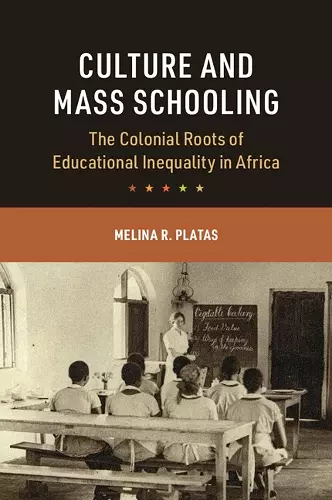
Reveals a widespread gap in education between African Muslims and Christians, and examines the role of culture in its persistence.
Education is central to politics, economic growth, and human well-being. Yet, large gaps in levels of education persist across different groups, often for generations. Why? This book argues that culture – specifically, community norms about schooling – plays a central role in explaining the persistence of educational inequality across groups.Education is central to politics, economic growth, and human well-being. Yet large gaps in levels of education persist across different groups, often for generations. Why? This book argues that culture – specifically, community norms about schooling – plays a central role in explaining the persistence of educational inequality across groups. Melina R. Platas uses the case of the Muslim-Christian education gap in Africa, where Muslims have on average three fewer years of education than Christians, to examine the origins and persistence of educational inequality. She documents the colonial origins of this gap and develops a cultural theory of its persistence, focusing on the case studies of Malawi, Nigeria and Uganda. Platas uses census and survey data from nearly 30 African countries, archival documents, interviews, focus groups, and coordination games to explore this ubiquitous yet underappreciated gap in educational attainment, and to measure divergent schooling norms across religious communities in Africa today.
'Why is there a persistent educational gap between Christians and Muslims in Africa, especially in predominantly Muslim areas? This innovative, rich study focuses on the transmission of colonial legacies and community values, and argues that where the colonial project sought to convert Muslims to Christianity, a skepticism about education led to a persistent gap. Melina Platas transforms our understandings of identity, informal institutions, and historical legacies.' Anna Grzymala-Busse, Stanford University
'Research on the provision of public goods assumes-as the label implies-that items like health care and schooling are universally valued. In this remarkable book, Melina R. Platas, shows that this is not always the case, and that the demand for such goods is shaped by deep-seated associations and norms forged by history. The variation in such norms across Christians and Muslims, Platas persuasively argues, is the key to understanding the notable and persistent gap in schooling outcomes across these communities in Africa.' Daniel N. Posner, University of California, Los Angeles
'Sharp, polished, and well argued, Platas carefully unravels the puzzle of the persistence of the gap in schooling between Christians and Muslims in Africa. Along the lines of classics like James Scott's Seeing Like a State or James Ferguson's The Anti-Politics Machine, she uses the leverage of an empirical puzzle to push past conventional niceties about the benefits of schooling, and emphasizes the key role that socialization plays – a role that is always political, always contested. Platas shows how decisions about control of the production of schooling can have long-lasting, differential impacts on communities and their norms today. A brilliant bit of social science and a valuable contribution to the next generation literature on the politics of schooling.' Lant Pritchett, London School of Economics and Political Science, 2025
ISBN: 9781009640367
Dimensions: unknown
Weight: 452g
276 pages