The Emergence of Social Complexity
A Global Archaeological Comparison
C Adam Berrey author Christian Peterson author Robert Drennan author
Format:Hardback
Publisher:Cambridge University Press
Publishing:31st May '26
£95.00
This title is due to be published on 31st May, and will be despatched as soon as possible.
This hardback is available in another edition too:
- Paperback£32.00(9781009702744)
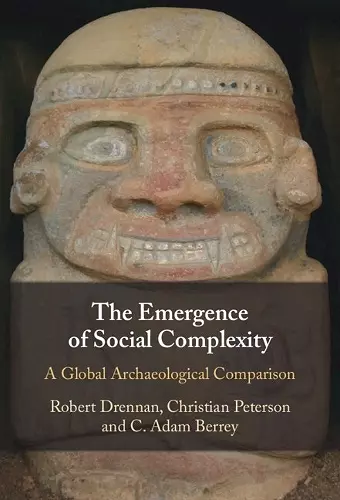
This book provides a global comparison of varied pathways to social complexity, revealing some of the forces that shape these trajectories.
Offering new insights into the forces that have shaped human societies for millennia, this volume provides readers reconstructions of past societies in all parts of the world. Using recently developed analytical approaches, the reconstructions presented here rest on fresh comparative analysis of archaeological data from 57 regions.The emergence of social complexity is at the heart of archaeological inquiry, but to date, there has been insufficient global comparative analysis of this phenomenon. This volume offers archaeologists and other social scientists reconstructions of past societies in all parts of the world, some of which challenge currently popular accounts. Using recently developed analytical approaches robust enough to yield compatible results from disparate datasets, the reconstructions presented here rest on fresh comparative analysis of archaeological data from 57 regions. They reveal the highly varied pathways to social complexity in ways that make it possible to see previously conflicting ideas as complementary. The analytical approaches and the full datasets are presented in detail in the book as well as an online data base. Offering new insights into the forces that have shaped human societies for millennia, this study provides a deeper understanding of the ways in which archaeology uses the material remains of past societies to reconstruct how they were organized.
'As only archaeology can document, Emergence of Social Complexity is foundational to an historical science of human societies. The authors creatively analyze rich archaeological evidence from many 'natural experiments'. They show how to rank key variables, such as monumentality, wealth, and population, to understand developmental interactions as 'rhymes in time.'' Timothy Keese Earle, Northwestern University
'A brilliant work examining patterns and pathways of emergent social complexity within what anthropologists traditionally recognize as chiefdom societies. This revolutionary contribution is one that every student and professional should read. It is slated to become a new reference on comparative studies within the field.' Kenneth Hirth, Penn State University
'This book represents the culmination of decades of comparative analyses of primary archaeological data on how early human societies developed as larger, more differentiated populations along varied pathways. It is critical reading for anyone interested in the emergence of institutions and hierarchies as well as the art of insightful societal comparison.' David Carballo, Boston University
'This book is methodologically and theoretically compelling. It tackles a thorny issue: how complex societies emerged. In comparing 57 cases, the authors show that no two trajectories are identical, and yet only a limited number of pathways exist. A powerful contribution to those yearning for the rigorous comparison of chiefdoms.' Joyce Marcus, University of Michigan
'This pioneering volume demonstrates the immense value of comparing diachronic sequences over static ethnographic snapshots. Combining consummate interrogations of the methodological and statistical pitfalls of comparison with an enormous global database, it dissects out a limited set of different pathways that 57 chiefdom societies took to complexity.' Paul Roscoe, University of Maine
ISBN: 9781009702737
Dimensions: unknown
Weight: unknown
300 pages