The Origins of War and Peace in the Human Species
Format:Hardback
Publisher:Cambridge University Press
Publishing:30th Sep '26
£40.00
This title is due to be published on 30th September, and will be despatched as soon as possible.
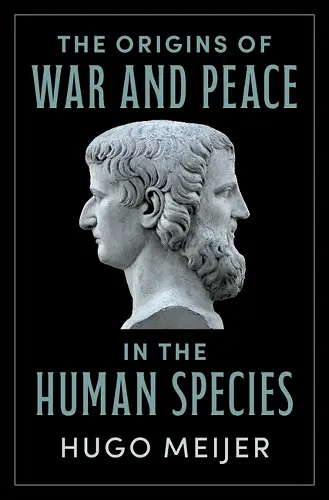
Explores how war and peace co-evolved in humans through biological, cultural, and environmental feedback loops over millions of years.
An ambitious interdisciplinary study tracing the evolutionary roots of humanity's dual capacity for war and peace. Synthesising insights from twelve disciplines and dozens of species, it offers a groundbreaking account of their co-evolution. Essential for all readers interested in the origins of war and peace.When, why, and how did we, humans, develop our distinctive and paradoxical inclinations for both war and peace? This groundbreaking book investigates that central question by drawing on cutting-edge research and an unprecedented range of evidence from thirteen disciplines: biology, primatology, comparative ethology, behavioural ecology, anthropology, archaeology, criminology, social psychology, linguistics, demography, genetics, neuroscience, and climatology. The book shows how the capacities for both war and peace co-evolved gradually over millions of years through a mosaic-like pattern, with distinct but interacting components emerging at different moments and becoming integrated over evolutionary time. This deep-rooted trajectory has been shaped by feedback loops among biological, cultural, and environmental forces. With its expansive temporal horizon, cross-species comparisons, and empirical richness, this book offers a sweeping new account – and an indispensable resource – for anyone interested in the origins of the Janus-faced inclination for both war and peace in the human species.
'Hugo Meijer's landmark natural history of humanity's tendencies for war and peace is far and away the richest and most complete analysis ever done. His balanced and invigorating analysis of this vital topic will be the go-to guide for decades.' Richard Wrangham, Author of The Goodness Paradox and Professor Emeritus of Biological Anthropology, Harvard University
'Is warfare innate to humanity or is cooperation equally hard-wired? This deep analysis of human evolution with a focus on this most existential question is eminently readable and scholarly at once. No reading list on International Relations, Strategic Studies or War Studies should miss this book.' Beatrice Heuser, Distinguished Professor, Brussels School of Governance, VUB, and Head of Strategy Teaching, German General Staff Academy
'Why are humans capable of both intense cooperation and devastating war? This book tackles this fundamental question through a broad and authoritative synthesis of research spanning anthropology, archaeology and evolutionary biology. It argues that group violence and cooperation are two sides of the same coin, deeply rooted in our evolutionary past, while challenging long-standing Rousseauian views that portray prehistoric hunter-gatherers as inherently peaceful.' Jean-Jacques Hublin, Chair of Paleoanthropology, Collège de France
'A meticulously researched interdisciplinary synthesis that engages deeply with a breadth of perspectives. This thought-provoking work provides a coherent and evidence-based treatment of a topic of fundamental importance to us all: the roots of humanity's capacity for both war and peace. It is essential reading for anyone seeking to understand the evolutionary underpinnings of the human condition.' Elva Robinson, Professor in Ecology, University of York
'The considerable amount of information gathered by Hugo Meijer to address the age-old question of the antiquity of war and peace in human history, combined with his cautious and critical use of the most recent and reliable data from a wide range of disciplines, immediately makes this work a classic in anthropology.' Jean-Loïc Le Quellec, Honorary Research Director at the CNRS, France
'Unlike previous works discussing the origins and nature of violent conflict, Meijer presents a rare feat: considered and critical interdisciplinary engagement with the available data and current debates. The result is an engaging and richly referenced narrative that embraces the complexity and variety of human behaviour across space and time.' Linda Fibiger, Senior Lecturer in Human Osteoarchaeology, University of Edinburgh
'Stories abound about our origins and inheritance, argued from plausibility; Meijer's book is not one of those. Instead, every step in his analysis is backed by careful and well-referenced evidence, with competing views considered fairly, building up a strong case that our paradoxical tendencies to waging war and negotiating peace have their origins deep in our pre-modern inheritance, coevolving into a complex mosaic of traits over several million years.' Dick Byrne, Emeritus Professor, University of St Andrews
'This book provides a rich, interdisciplinary account of the roots of war and peace, emphasising the interplay of biological, cultural and environmental forces. Its treatment of climate variability within a framework of interacting forces and feedbacks, reminiscent of the climate system itself, is especially insightful.' Jessica Conroy, Professor in the Department of Earth Science and Environmental Change, University of Illinois at Urbana–Champaign
'A brilliant journey in search of the roots of the unique human ability to produce both brutal aggression and peaceful coexistence. This is the most meticulously documented analysis of the interplay between humans' biological heritages and the ability for cultural innovations. A stunning exploration of facts, hypotheses and speculations on our distant past.' Luigi Boitani, Emeritus Professor of Animal Ecology and Conservation Biology, Sapienza University of Rome
ISBN: 9781009714495
Dimensions: unknown
Weight: unknown
766 pages