Closing the Institutional Gap
How Foreign Investors Shape Domestic Institutions in Emerging Markets
Format:Paperback
Publisher:Cambridge University Press
Publishing:31st Oct '26
£28.00
This title is due to be published on 31st October, and will be despatched as soon as possible.
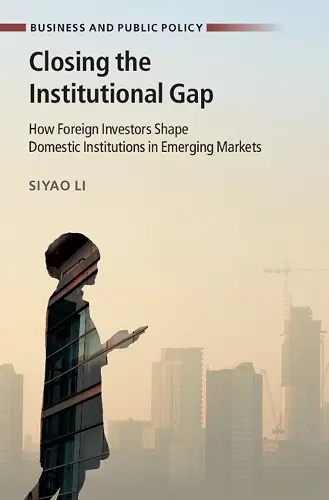
Reveals how foreign firms shape institutions in emerging markets to safeguard their intellectual property.
Reveals how multinational corporations reshape domestic institutions in emerging markets to protect their intellectual property-transforming weak rule-of-law environments from the inside out. A must-read for students and scholars of global politics, business, and law.As multinational corporations (MNCs) expand their global presence, they actively shape the legal and institutional frameworks that govern foreign markets. Challenging the conventional view that firms primarily rely on external institutions to safeguard their property rights in countries with weak rule of law, this book argues that domestic institutions serve as critical arenas where MNCs advocate for stronger laws and enforcement, with a particular focus on intellectual property protection. Drawing on original datasets, survey experiments, and interviews with business executives, lawyers, and policymakers, Siyao Li reveals how home governments negotiate with host governments at the behest of MNCs, while the firms themselves play a central role in ensuring that these commitments translate into effective enforcement. At a time when global rule-making is shifting from multilateral cooperation towards bilateral negotiations and national-level policymaking, this book offers fresh insights into the evolving interplay of business power, state sovereignty, and global governance.
'In 'Closing the Institutional Gap', Siyao Li analyzes the ways international corporations try to protect their assets, especially their intellectual property. In a novel analysis, she argues that multinational investors use a variety of legal, political, and diplomatic methods to get host countries to enact 'institutional' protections for the corporations' intangible assets. This book is a valuable contribution to our understanding of the politics of international investment, especially in the economically and politically crucial economic sectors that rely on secure intellectual property rights.' Jeffry Frieden, Columbia University
'This book shows how multinational firms work with governments in emerging markets to strengthen intellectual property protections and advance institutional reform. Rather than passively adapting to local conditions, firms leverage their technological assets to shape domestic norms and expand the rule of law. Combining in-depth interviews with statistical analysis, Li offers a compelling account of firms as agents of institutional change.' Christina L. Davis, Edwin O. Reischauer Professor of Government, Harvard University
'An outstanding scholarly contribution that examines how multinational firms protect their investments in countries characterized by weak institutions and limited rule of law. Professor Siyao Li advances a novel theoretical framework explaining how firms shape domestic institutions to safeguard their investments and rigorously tests this framework through sophisticated statistical analyses and in-depth interviews with decision-makers. This book is essential reading for scholars of international political economy and international business.' Nathan M. Jensen, Professor, Department of Government, University of Texas,Austin
'Against today's backdrop of global geopolitical fracturing, Siyao Li synthesizes insights from trade practitioners with data on institutional reforms to assess the ways multinational companies are changing how they interact with host governments to foster the rule of law and protect their intellectual property rights, ultimately protecting other property rights. How far this shift goes will have profound effects on the development of the global south.' Fred Burke, Senior Advisor, Baker McKenzie Vietnam
ISBN: 9781009730099
Dimensions: unknown
Weight: unknown
270 pages