Constitutionalising Anarchy
Ruth Kinna author Alex Prichard author
Format:Paperback
Publisher:Cambridge University Press
Publishing:30th Sep '26
£40.00
This title is due to be published on 30th September, and will be despatched as soon as possible.
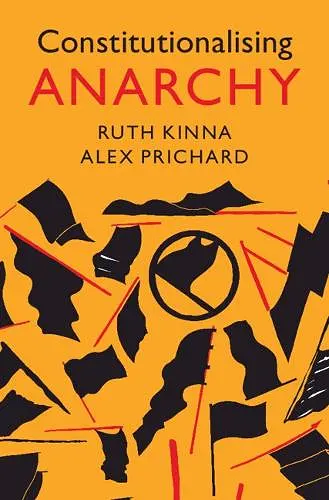
By revealing how anarchists routinely constitutionalise, this book reshapes core assumptions about anarchy, law, politics, and violence.
Anarchists routinely engage in constitutional practice. Drawing on over a decade of research co-produced with anarchist groups, this book shows how anarchism generates practical, emancipatory approaches to constitutional politics open beyond anarchist movements. This title is also available as open access on Cambridge Core.Anarchism is often assumed to stand outside constitutionalism, yet it forms a significant, if overlooked, tradition of constitutional thought. Addressing global constitutional crises and the impasses of state-centred politics, this book brings anarchism into productive dialogue with constitutional, political and international theory. At its core is a reconstruction of anarchist social theory grounded in an ontology of anarchy shaped by European social science and republican concerns with dividing and balancing power. These ideas were reinterpreted by major anarchist thinkers - from Proudhon to Lucy Parsons, and from Tolstoy to Kōtoku Shūsui - who advanced decentralised, federalist alternatives to imperial and hierarchical orders. Combining intellectual history with co-produced research alongside anarchist groups, Constitutionalising Anarchy shows how constitutional practices developed within militant labour unions, protest movements and cooperatives across the twentieth century. It reconsiders anarchy, constitutionalism and the possibilities of political organisation. This title is also available as open access on Cambridge Core.
''Constitutionalising Anarchy' is easily one of the most thought-provoking and groundbreaking works on anarchist theory published this century. Kinna and Prichard masterfully bridge the gap between powerful examples of anarchy in action and intellectual histories of societal norms-making to challenge dominant statist paradigms. This is an urgent appeal for activists to further conceptualize their organizational structures and political theorists to take seriously the anti-state tradition of collective decision-making from below.' Mark Bray, Assistant Teaching Professor, Rutgers University-New Brunswick and Author of 'The Anarchist Inquisition: Assassins, Activists, and Martyrs in Spain and France'
'Kinna and Prichard show how anarchism, grounding and shaping an emancipatory politics, can offer an appealing and viable alternative to modern conceptions of politics as rooted in state sovereignty. Combining insights from a range of disciplines and attending to both historical and contemporary examples, they argue provocatively that, far from disregarding or attacking social order, anarchism embodies a conception of our common life that enables constitutional order to emerge from the bottom up.' Gary Chartier, Distinguished Professor of Law and Business Ethics, La Sierra University
'Combining academic rigor with deep inside knowledge of its subject, this book is a major landmark in anarchist thought. Bridging anarchism´s fundamentals with contemporary theory and practices, the authors shed new light on the often-overlooked constitutional dimension of anarchism. This opens exciting directions for an anarchism deeply rooted in everyday life.' Tomás Ibáñez, Professor of Social Psychology, Universidad Autonoma de Barcelona, Spain
'Kinna and Prichard not only make a convincing, counterintuitive case that anarchism is compatible with constitutionalism, they demonstrate that constitutional anarchy is the only institutional form appropriate for our contemporary world, where power relations have radically changed on the local, national, and global level. 'Constitutionalising Anarchy' is an instant 'must read' in contemporary democratic theory.' John P. McCormick, University of Chicago and author of 'Machiavellian Democracy' (Cambridge University Press 2011)
'This bold and original book is a springboard for reimagining constitutional politics without the state. Moving nimbly between political theory, history and rich empirical case studies, it uncovers a hidden tradition of anarchist constitutionalising and shows how anarchy can organise, rather than destroy, social order. Accessible yet rigorous, it offers activists and scholars a powerful new language for thinking about domination, democracy and global justice, and makes a compelling case that the future of constitutionalism lies in federated, bottom-up experiments in freedom and creativity.' Patricia Owens, Professor of International Relations, University of Oxford
'Kinna and Prichard deftly uncover a neglected body of anarchist political theory and practice extending from Kropotkin and Proudhon in the 19th century to radical 21st century movements such as Occupy and Industrial Workers of the World. They untether anarchy from its connotations as constitutionalism's nemesis. Their timely and masterful book brings anarchist thought back to the fore of public debate opening possibilities to think constitutionalism and anarchism beyond the state. A must read for all those interested in radical new alternatives.' Manjeet Ramgotra, Senior Lecturer in Political Theory, SOAS University of London
'Professors Kinna and Prichard have co-created an outstanding intellectual history and contemporary political theory and practice of participatory democratic constitutional anarchy at the local, federal, and global levels. They also argue for its superiority to state-based sovereign constitutionalism.' James Tully, Emeritus Professor, University of Victoria, Canada
'This book offers a thoroughly innovative take on constitutionalism. By unearthing the origins and inherently constructive aspect of 'an-archy', Kinna and Prichard present a most welcome novel take on anarchy as a normative organising principle in late modern times. Conceived in this way, anarchy enables us to grasp the full range of 'constituent power beyond the state' in appreciation of 'post-colonial, liberal and socialist critics of domination and arbitrary power'. As such the book makes fascinating reading, a must-read, especially for students of International Relations but also for Political Scientists more generally.' Antje Wiener, Chair of Political Science especially Global Governance and Professor of Law, University of Hamburg & By-Fellow, Hughes Hall, University of Cambridge
ISBN: 9781009785471
Dimensions: unknown
Weight: unknown
380 pages