Rehumanizing Muslim Subjectivities
Postcolonial Geographies, Postcolonial Ethics
Format:Hardback
Publisher:Taylor & Francis Ltd
Published:31st Jan '24
Currently unavailable, and unfortunately no date known when it will be back
This hardback is available in another edition too:
- Paperback£47.99(9781032678467)
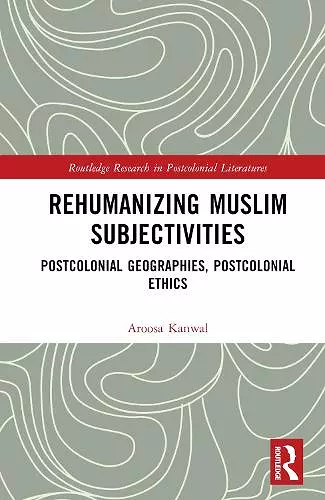
Rehumanizing Muslim Subjectivities: Postcolonial Geographies, Postcolonial Ethics is a timely and urgent monograph, allowing us to imagine what it feels like to be the victim of genocide, abuse, dehumanization, torture and violence, something which many Muslims in Palestine, Kashmir, Pakistan, Myanmar, Syria, Iraq and China have to endure. Most importantly, the book emphasizes the continued relevance of creative literature’s potential to intervene in and transform our understanding of a conceptual and political field, as well as advanced technologies of power and domination. The book makes a substantial theoretical contribution by drawing on wide-ranging angles and dimensions of contemporary drone warfare and its related catastrophes, postcolonial ethics in relation to the thanatopolitics of slow violence, dehumanization and the politics of death. Against the backdrop of such institutionalized and diverse acts of violence committed against Muslim communities, I call the postcolonial Muslim world ‘geographies of dehumanization’. The book investigates how ongoing legacies of contemporary forms of injustice and denial of subjecthood are represented, staged and challenged in a range of postcolonial anglophone Muslim texts, thereby questioning the idea of postcolonial ethics. One of the selling points of this book is the chapters on fictional representations by Muslim Myanmar and Uyghur writers as, to the best of my knowledge, no critical work or single authored book is available on Myanmar and Uyghur literature to date.
In Rehumanizing Muslim Subjectivities, Kanwal (Quaid-e-Azam Univ., Pakistan) dissects ongoing major global human tragedies, such as unimpeded genocide, torture, violence, and discrimination in China, Iraq, Kashmir, Myanmar, Pakistan, and Palestine. The author confronts the international community’s utter silence and exposes its rare lip service to systemic victimization, dehumanization, body-crushing, and total annihilation of Muslim communities. Deploying various critical theoretical approaches, Kanwal’s book highlights the overlooked literary works of writers who, in their turn, arduously endeavor to make visible the agony of the invisible and give voice to the voiceless. Kanwal shares key narratives from plays, novels, autobiographies, reportage, and diaries, and deftly conducts a contextualized analysis of critical themes: citizenship, refugees, asylum, camps/encampments, human rights, dispossession, loss (including mourning non-human structures), violence, and the de-subjectification of refugees and their traumas. The uniqueness of this book lies in its effort to accentuate creative writing by Muslim authors, from the Rohingya people in Myanmar to the Uyghur community in China. The writers share a personal stake in their experience of dehumanization enterprises and tell their own harrowing stories. Learned and stylistically accessible, this book serves as an important reference for postcolonial, ethnic, and cultural studies.
--H. Bahri, The City University of New York, York College
ISBN: 9781032008844
Dimensions: unknown
Weight: 394g
170 pages