The Magic Theorem
A Greatly-Expanded, Much-Abridged Edition of The Symmetries of Things
John H Conway author Heidi Burgiel author Chaim Goodman-Strauss author
Format:Paperback
Publisher:Taylor & Francis Ltd
Published:10th Jul '25
Should be back in stock very soon
This paperback is available in another edition too:
- Hardback£145.99(9781032182735)
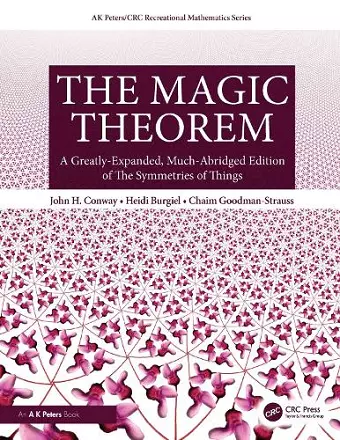
The Magic Theorem: a Greatly-Expanded, Much-Abridged Edition of The Symmetries of Things presents a wonder- fully unique re-imagining of the classic book, The Symmetries of Things. Begun as a standard second edition by the original author team, it changed in scope following the passing of John Conway. This version of the book fulfills the original vision for the project: an elementary introduction to the orbifold signature notation and the theory behind it.
The Magic Theorem features all the material contained in Part I of The Symmetries of Things, now redesigned and even more lavishly illustrated, along with new and engaging material suitable for a novice audience. This new book includes hands-on symmetry activities for the home or classroom and an online repository of teaching materials avaialble at themagictheorem.com
“The Magic Theorem is a joyful exploration of symmetry and the elegant geometry of orbifolds. Conway, Burgiel, and Goodman-Strauss have created something rare: a book that distills deep mathematics into a playful, visually stunning experience. Whether you're encountering these ideas for the first time or rediscovering them with fresh eyes, this is a guided tour filled with clarity, wonder, and charm.”
—Steven Strogatz, Professor of mathematics at Cornell University and bestselling author of Infinite Powers
"The present book has a predecessor: The Symmetries of Things, by the same authors, a hefty 400 pages, published in 2008. Conway still worked significantly on this new work, therefore, while his co-authors Heidi Burgiel and Chaim Goodman-Strauss have "much expanded and much abridged" it for this new version, meaning they omitted numerous consequences of the orbifold concept and instead expanded the introduction up to the magic theorem through a wealth of examples. The older book wanted to appeal to "laypeople, artists, active mathematicians, and researchers in general." This new work undoubtedly fulfils this claim as well.
As for me, the restriction of the new version to the first part of The Symmetries of Things was actually successful. While I never dared approach the old, much longer book, I was able to consume the new one with profit. And this despite the fact that I haven't been so keen on practice problems since the end of my studies and have skipped the abundantly scattered exercises ("Here is a pattern, find its symmetries")."
—Christoph Pöppe, Spektrum der Wissenschaft (translated from the original German article)
"The Symmetries of Things was — is — a magical book; it even has a Magic Theorem! This extended as well as abridged new version (a magical combination in itself) is a welcome (and more affordable!) introduction into the joys of seeing, understanding and constructing symmetries."
—Ingrid Daubechies, inventor of the Daubechies wavelet and other widely used image compression techniques
"The Magic Theorem is a joyful exploration of symmetry and the elegant geometry of orbifolds. Conway, Burgiel, and Goodman-Strauss have created something rare: a book that distills deep mathematics into a playful, visually stunning experience. Whether you’re encountering these ideas for the first time or rediscovering them with fresh eyes, this is a guided tour filled with clarity, wonder, and charm."
—Steven Strogatz, author of Infinite Powers, The Joy of x, and other award winning mathematical books for the wider public
"Leaving behind the graduate-level math, Burgiel and Goodman-Strauss have extracted the simplest, most widely appealing part of their earlier book The Symmetry of Things (co-authored with the late John Conway) and expanded it out to a more accessible exposition for a broader audience. With clear explanations and a warm, friendly tone, the text sounds more like the way the authors might explain their ideas to some friends over a beer than what you’d find in a typical math book. And of course the illustrations are every bit as gorgeous as in the authors’ earlier book. More demanding on the reader’s time and energy than a pure popularization, but far less demanding than a typical math book, The Magic Theorem seems ideal for mathematically inclined non-specialists looking for a deeper understanding of symmetry."
— Jeff Weeks, author of The Shape of Space, innovative developer of geometric visualization tools
"Can you handle looking straight into the most fundamental core of the beauty of existence? If you are ready, then this book is where to start."
— Jaron Lanier, VR pioneer and author of You Are Not A Gadget
"Have you ever admired the wallpaper in your aunt’s bathroom? Read this book, and you will learn how to identify for her which of the 17 possible wallpaper patterns she displays. Richly illustrated with objects from everyday life, The Symmetries of Things leads you on a journey from everyday patterns seen in architecture and on the soccer pitch to the esoteric world of hyperbolic surfaces and orbifolds. Ample exercises allow one to practice the craft of wallpaper, frieze and game ball pattern identification until it becomes second nature. Not sure you will impress your aunt with your dinner banter, but your D&D friends will be awed when you can categorize the polyhedral dice you are playing with. And if you are not careful, you may develop a desire to learn about higher dimensional patterns underlying crystals, knots and more!"
—Ian Agol, esteemed geometric topologist, U.C. Berkeley
"The present book has a predecessor: The Symmetries of Things, by the same authors, a hefty 400 pages, published in 2008. Conway still worked significantly on this new work, therefore, while his co-authors Heidi Burgiel and Chaim Goodman-Strauss have "much expanded and much abridged" it for this new version, meaning they omitted numerous consequences of the orbifold concept and instead expanded the introduction up to the magic theorem through a wealth of examples. The older book wanted to appeal to "laypeople, artists, active mathematicians, and researchers in general." This new work undoubtedly fulfils this claim as well.
As for me, the restriction of the new version to the first part of The Symmetries of Things was actually successful. While I never dared approach the old, much longer book, I was able to consume the new one with profit. And this despite the fact that I haven't been so keen on practice problems since the end of my studies and have skipped the abundantly scattered exercises ("Here is a pattern, find its symmetries")."
—Christoph Pöppe, Spektrum der Wissenschaft (translated from the original German article)
"I sense that this book, being more approachable and up-to-date than its predecessor, will not only serve as an entry-point for new researchers in this field, but will also encourage all mathematicians to see symmetries in their mathematical work and the world around them."
—Dr. Emily J Olson, AMS Notices
"[T]he present book—almost a coffee-table book—takes its material slowly and with illustrations and exercises (with solutions) which make the material accessible to anyone with a good feeling for surface topology and the willingness to work through enumerations with care."
—Dr. Peter Giblin, The Mathematical Gazette
ISBN: 9781032162003
Dimensions: unknown
Weight: 360g
190 pages