Dissociative Retreat and Addiction
Trauma, Dissociation, and Affect Dysregulation
Format:Paperback
Publisher:Taylor & Francis Ltd
Publishing:10th Aug '26
£34.99
This title is due to be published on 10th August, and will be despatched as soon as possible.
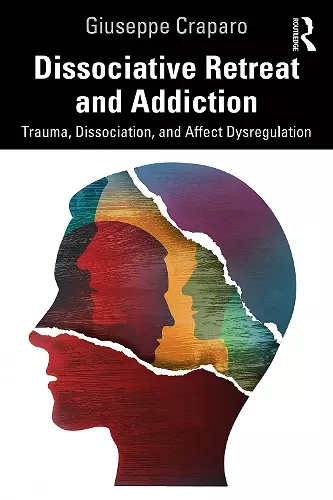
Dissociative Retreat and Addiction presents a new theoretical and clinical model for understanding and treating addiction. Giuseppe Craparo examines how addictive behaviors develop as the result of complex psychic and physical conditions, working in conjunction with a specific drug object, and explores factors including poor relational and developmental history, strong emotional pain and psychopathological conditions including anxiety, depression, personality disorders and psychosis. Craparo’s clinical, developmental-relational model conceptualizes addictive symptoms as reenactments of traumatic memories and observes how drug objects are used as defensive somato-psychic retreats from the intense emotions associated with traumatic memories. The book provides a full overview of the model with clinical examples and theoretical underpinnings. Dissociative Retreat and Addiction will be of great interest to psychoanalysts, psychotherapists and other professionals working with addiction and trauma.
"If you want to know how addiction works, if you want to learn to treat addiction well, read this book. Updating and integrating the study of addiction with psychoanalytic/trauma/dissociation literature and recent findings in neurology, Giuseppe Craparo makes his complex conceptualizations easy to understand. Linking early trauma with inadequate mentalization, symbolization, and integration, he brilliantly explains how early traumatic and dissociated experiences become embodied and somato-psychic. The purpose of what he calls “the drug object” is to regulate unintegrated, powerful, often unbearable affects associated with traumatic early unnegotiated and often unnegotiable relationships. In this way the user has the illusion of control and self-sufficiency. Craparo cogently explains how dissociation is imbricated with problematic drug use: when the drug aestheticizes the pain—reinforcing dissociative defenses, the person is deprived of the experience of accepting and integrating painful affects that may feel unbearable with the rest of current life (along with the requisite mourning) and thus is deprived of the opportunity of learning from experience. A brilliant piece of work that should be read by all who treat addictions."
Elizabeth F. Howell, PhD, Faculty, New York University Postdoctoral Program in Psychotherapy and Psychoanalysis
"This book has the scope of a manual and the density of a treatise. Giuseppe Craparo succeeds in condensing a profound and rigorous reflection on one of the most complex issues in psychopathology, applying it specifically to the clinical treatment of addiction. The book’s most significant contribution lies in the Developmental–Relational psychopathological model of addiction it proposes. Within this framework, multiple pathogenic processes are interwoven, while the self-therapeutic function of substance use—aimed at regulating mental states dysregulated by attachment-related trauma—clearly emerges. The resulting therapeutic approach is highly coherent with the proposed model and is distinguished by a rare conceptual clarity, making it accessible and clinically useful even for practitioners with less extensive experience."
Benedetto Farina, Psychotherapist and Full professor of Clinical Psychology at the European University of Rome, Italy
ISBN: 9781032351056
Dimensions: unknown
Weight: 230g
122 pages