The Transnationalisation of Turkish Islam
Authority, Legitimacy, and Influence Beyond Borders
Format:Hardback
Publisher:Taylor & Francis Ltd
Published:27th Jul '26
Currently unavailable, and unfortunately no date known when it will be back
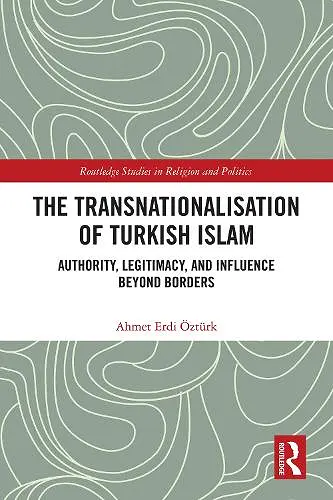
The Transnationalisation of Turkish Islam builds on current academic debates pertaining to the use of religion in global politics. By examining how and why religion is used as a tool for foreign policy aims, as well as for perpetuating a state’s identity and institutional capacity at home and abroad, the book presents a theory-informed discussion on contemporary Turkey’s transnational politics of religion from a comparative perspective. The country’s use of religion as a political tool outside of its borders has been studied in Continental Europe, Africa, Asia, and the Balkans thanks to extensive fieldwork and interviews conducted between 2016 and 2020.
The book investigates how and why Turkey has implemented similar tools with different aims in different geographic territories and the underlying material and normative motivations for this pursuit. The main argument presented in the study is that Turkey, under the rule of the Adalet ve Kalkınma Partisi (AKP) (Justice and Development Party), employs religion for three fundamental reasons: to bolster its regional and global influence, to access regions or groups that are difficult to reach through traditional foreign policy tools, and to alter domestic political balances or amass power.
The Transnationalisation of Turkish Islam will appeal to students and scholars of political science, international relations, and public policy.
"Incorporation of religion into Turkish foreign policy has been one of the most consequential novelties since the Islamism-originated Justice and Development Party, led by Recep Tayyip Erdoğan, came to power in 2002. Defining this novelty as “positive instrumentalization” or “repurposing” of religion congruent with the historical patterns of state-religion relations in “secular” Turkey, The Transnationalization of Turkish Islam meticulously examines how religion has been functionalized as a medium of civilizational performance to claim the status of a central Muslim power, guarding a broader religious-cultural heritage than that of the nation. By engaging with post-secular international relations, soft power, field theory and civilizational politics, A. Erdi Öztürk distills his ethnographic research, involving representatives of Turkey’s official, semi-official and non-official religious functionaries, Turkish diplomats, and selected local religious leaders and community actors, in a wide geography spanning from post-Soviet Eurasia to the Anglo-Saxon world. The consequent analysis is a sophisticated one revealing how religion is strategically utilized to attain legitimacy, amplify influence, and enhance civilizational prestige, while simultaneously isolating dissenters both domestically and abroad; how this mobilization is varied/differed depending on the audiences, institutional interlocutors and geopolitical constraints involved; and how in the process religion is defined, owned and authorized by the very political force claiming to have submitted itself to serving it. The Transnationalization of Turkish Islam is an essential reading for students and scholars of Turkish politics, Islamism, civilizational states, comparative politics and international relations, providing critical insights into the complex interplay of religion and statecraft in contemporary Turkey, shedding light on a pivotal aspect of Turkish foreign policy, and contributing to a broader understanding of the role of religion in global politics today."
Menderes Çınar, Professor of Political Science and International Relations, Başkent University, Ankara
ISBN: 9781032410111
Dimensions: unknown
Weight: 500g
172 pages