Tropes and the Literary-Scientific Revolution
Forms of Proof
Format:Hardback
Publisher:Taylor & Francis Ltd
Published:2nd Apr '24
Currently unavailable, and unfortunately no date known when it will be back
This hardback is available in another edition too:
- Paperback£47.99(9781032422992)
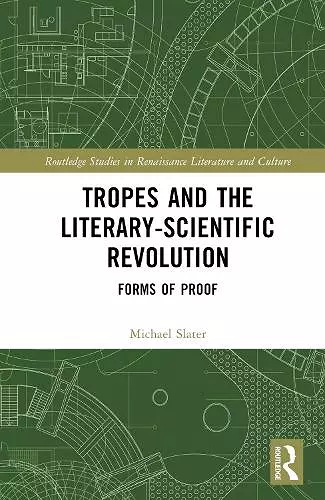
Tropes and the Literary-Scientific Revolution: Forms of Proof argues that the rise of mechanical science in the seventeenth century had a profound impact on both language and literature. To the extent that new ideas about things were accompanied by new attitudes toward words, what we commonly regard as the “scientific revolution” inevitably bore literary dimensions as well. Literary tropes and forms underwent tremendous reassessment in the seventeenth century, and early modern science was shaped just as powerfully by contest over the place of literary figures, from personification and metaphor to anamorphosis and allegory. In their rejection of teleological explanations of natural motion, for instance, early modern philosophers often disputed the value of personification, a figural projection of interiority onto what was becoming increasingly a mechanical world. And allegory—a dominant mode of literature from the late Middle Ages until well into the Renaissance—became “the vice of those times,” as Thomas Rymer described it in 1674. This book shows that its acute devaluation was possible only in conjunction with a distinctively modern physics. Analyzing writings by Sidney, Shakespeare, Bacon, Jonson, Brahe, Kepler, Galileo, Hobbes, Descartes, and more, it asserts that the scientific revolution was a literary phenomenon, just as the literary revolution was also a scientific one.
C. P. Snow’s 1959 lecture “The Two Cultures” lamented the modern divide between the sciences and the humanities. In this new book, Slater (SUNY Brockport) demonstrates that, in the 17th century, these two were intimately connected. In science, the Aristotelean animistic world view was being supplanted by a mechanistic one. For Aristotle, a rock falls because it seeks its natural place at the center of the earth. For modern science, a rock falls because external forces act on it. Slater maintains that removing volition from inanimate objects led to the rejection of allegory. Sir Philip Sidney’s Apology for Poetry (1595) champions allegory. By 1678, when John Bunyan published The Pilgrim’s Progress, he felt obliged to apologize for it. In a fascinating chapter on Hamlet and astronomy, Slater notes how the play draws on both Copernican and Ptolemaic cosmologies: Hamlet embraces the new science, Claudius and Polonius the old. Ptolemy’s first name was also Claudius. Yet as Slater shows, even scientists in the 17th century did not completely eschew allegory. Galileo argued that, if the Bible is read allegorically, it would not conflict with his observations. Altogether an illuminating work.
--J. Rosenblum, formerly, University of North Carolina at Greensboro
ISBN: 9781032422718
Dimensions: unknown
Weight: 580g
222 pages