Act and Omission in Criminal Law
Autonomy, Morality and Applications to Euthanasia
Format:Hardback
Publisher:Taylor & Francis Ltd
Published:30th Aug '24
Currently unavailable, and unfortunately no date known when it will be back
This hardback is available in another edition too:
- Paperback£47.99(9781032461748)
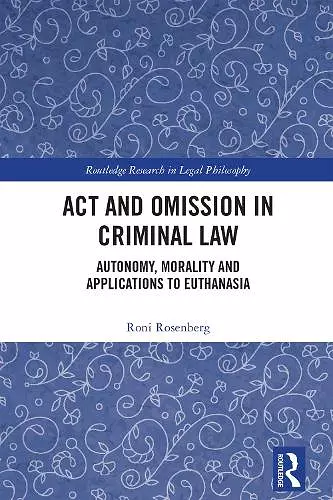
This book offers an innovative perspective on the critical distinction between acts and omissions in criminal law, a distinction that runs like a defining thread through all types of criminal offenses.
While any act that positively causes a prohibited harm is sufficient for a conviction, an omission that causes the very same harm warrants a conviction only when there is a legal duty to act. This fundamental distinction between acts and omissions is not just relevant to criminal law, but it is also deeply rooted in our moral thinking. Thus, it is commonly argued that the difference between acts and omissions is also applicable to the intuitive moral distinction between active euthanasia, forbidden in most countries, and passive euthanasia, permitted in many countries under certain circumstances. Hence, the significance of this book is threefold: First, it offers a comprehensive, coherent, and systematic discussion of the intersections between the philosophical-moral and the legal-criminal aspects of this fundamental topic. Second, it offers a novel rationale for the distinction between acts and omissions, based on the principle of autonomy. Finally, it demonstrates the influences of the theoretical discussion, on the most significant practical questions.
This book will be of interest to researchers, academics and policy-makers working in the areas of criminal law, moral philosophy, and bioethics.
“Professor Rosenberg provides exceptionally thorough analyses of the legal and moral distinctions between acts and omissions. This book is a must-read by anyone reflecting on this topic and its policy implications in drawing sensible lines between our criminal laws and our moral judgments.”
—Joshua Dressler, Distinguished University Professor Emeritus, Michael E. Moritz College of LawThe Ohio State University
“Roni Rosenberg has produced a comprehensive treatment of how the philosophical and legal complexity of the contrast between acts and omissions applies to substantive controversies, especially the permissibility of euthanasia. But his book is so much more. It also contains a sophisticated examination of several of the most foundational issues in all of moral and legal philosophy.”
—Douglas Husak, Distinguished Professor (Emeritus), Rutgers University
“This book provides an enlightening, thorough, and original analysis of one of the challenging issues in moral and legal philosophy – the distinction between acts and omissions. Through a fascinating exploration of various rationales for this prevailing distinction, Roni Rosenberg sharply unpacks fundamental theoretical issues in substantive criminal law and demonstrates the practical implications of his analysis.”
—Hadar Dancig-Rosenberg [no relation to the author], Professor of Law, Bar-Ilan University; Visiting Professor of Law, Northwestern Pritzker School of Law (2023-2024)
`The book offers a sophisticated analysis that advances our understanding of fundamental questions in criminal law theory. Rosenberg's work will reward careful study by anyone interested in the philosophical foundations of criminal responsibility, and it deserves a prominent place in ongoing debates about the act/omission distinction.’
—Keele Law Review, Volume 5 (2024/25), 111-119 ISSN 2732-5679
`The book serves as a rich source of knowledge for researchers, judges, attorneys, and even legislators seeking to confront the complexity of the distinction between act and omission. It offers theoretical and practical tools that can illuminate the intricate path to the important distinction between act and omission. Reading the book invites the reader to not only re-examine age-old assumptions of criminal law and morality but also to courageously reflect on the normative and institutional structures that have the power to shape the boundaries of criminal liability. This work deserves a place in the canon of scholarship on the subject and stands as a central point of reference for anyone seeking to engage with it.
—NUJS Law Review, 18 NUJS L.Rev 3 (2025); ISSN-L (Online): 0975-0207; ISSN (Print): 0975-0029
`[This] is a distinctive and ambitious work that places at its center one of the most challenging questions in criminal law: the distinction between “act” and “omission.” …This inquiry exposes the tension between moral and legal justifications for imposing liability and clarifies that the distinction between act and omission reflects not a formal dichotomy, but a conceptual framework for balancing individual liberty and criminal responsibility. In this way, the book not only sharpens theoretical understanding but also equips practitioners with tools to avoid over-expansion of liability, preserving liberty and justice alike.’
—Crime, Law and Social Change (2025) 83:60; https://doi.org/10.1007/s10611-025-10243-4
ISBN: 9781032461731
Dimensions: unknown
Weight: 440g
184 pages