Counter-Memory, Hope and Aspirations
A Case Study of 26/11 Mumbai Terror Attack
Jacquleen Joseph author Surinder K P Jaswal author Allan Mathew Alex author Lavanya Shanbhogue Arvind author
Format:Hardback
Publisher:Taylor & Francis Ltd
Published:26th Feb '26
Currently unavailable, and unfortunately no date known when it will be back
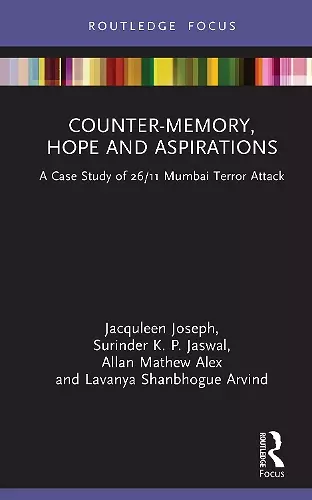
This book explores the voices of terror-attack survivors, focusing on their experiences of hope and hopelessness, memory and counter-memory, and aspirations and counter aspirations. It establishes linkages between the three to understand how they can be structured into a framework to aid terror survivors.
Focusing on the survivors of the 26/11 Mumbai attacks of 2008, the book explores how hope, memory and aspiration influence healing and resilience. It explores the role that hope, memory and aspirations play in recovery. It looks at the agency of the survivors, public memory and disillusionment, and through narratives of the survivors, presents the struggles they go through in the aftermath of the trauma. The book proposes a new lens for understanding the long-term effects of terror events and the lived realities of those who survive them.
It will be of interest to researchers and academics of disaster management, conflict and conflict resolution, political science and international studies, as well as terror survivor communities. It will also be useful to policy makers and bureaucrats, those working with the rehabilitation of terror survivors.
‘The Authors bring with them long term experience and expertise in the subject of Disasters- of all types. This publication will add to the understanding of the humanitarian aspects of one such terrible event. The serialization of how the human emotions, and the coping mechanism related to such traumatic events in meaningful ways, building resilience.’
Nimesh G Desai, Psychiatrist and Public Health Professional
‘The act of terrorism is inhuman and a devastating pathology for humanity. This book highlighted the lived and felt experiences of the survivors of terror attacks from a perspective that showed the internalization of pain and the formation of memory in the personal and public spheres, which are often submerged in the space of time, the nation’s priority, and similar other events. The book essentially emphasized the process and importance of navigating towards building hope, aspirations from the eyes of the survivors of the Mumbai terror attack of 2008.’
Subhasis Bhadra,Professor of Psychiatric Social Work, Head of the Department of Psychosocial Support in Disaster Management, National Institute of Mental Health and Neuro Sciences (NIMHANS), Bengaluru, India.
‘The manuscript will be an asset for the field of disasters as it critically looks at the nature of memorialization over a 10-year period between 2009-2019. Further the manuscript will be of immense value for disaster social worker practitioners and educators as it delves into the spatial and emotional significance of memorials, analysing how they function as sites of collective mourning, reflection, and resilience.’
Ankur Saxena,Dean, Department of Social Work, MS Baroda University, Vadodara, Gujarat, India.
“The Authors bring with them long term experience and expertise in the subject of Disasters of all types. This publication will add to the understanding of the humanitarian aspects of one such terrible event. The serialization of how the human emotions, and the coping mechanism related to such traumatic events in meaningful ways, building resilience”.
—Nimesh G Desai, Psychiatrist and Public Health Professional
“The act of terrorism is inhuman and a devastating pathology for humanity. This book highlights the lived and felt experiences of the survivors of terror attacks from a perspective that shows the internalization of pain and the formation of memory in the personal and public spheres, which are often submerged in the space of time, the nation’s priority, and similar other events. The book essentially emphasizes the process and importance of navigating towards building hope, aspirations from the eyes of the survivors of the Mumbai terror attack of 2008”.
—Subhasis Bhadra, Professor of Psychiatric Social Work, Head of the Department of Psychosocial Support in Disaster Management, National Institute of Mental Health and Neuro Sciences (NIMHANS), Bengaluru, India.
“The manuscript will be an asset for the field of disasters as it critically looks at the nature of memorialization over a 10-year period between 2009 and 2019. Further the manuscript will be of immense value for disaster social worker practitioners and educators as it delves into the spatial and emotional significance of memorials, analysing how they function as sites of collective mourning, reflection, and resilience”
—Ankur Saxena, Dean, Department of Social Work, MS Baroda University, Vadodara, Gujarat, India.
ISBN: 9781032520544
Dimensions: unknown
Weight: 410g
120 pages