Kerala Transforming
Labor and Trade Mobility in times of Pandemic
Thiagu Ranganathan editor PL Beena editor
Format:Hardback
Publisher:Taylor & Francis Ltd
Published:18th Jul '25
Currently unavailable, and unfortunately no date known when it will be back
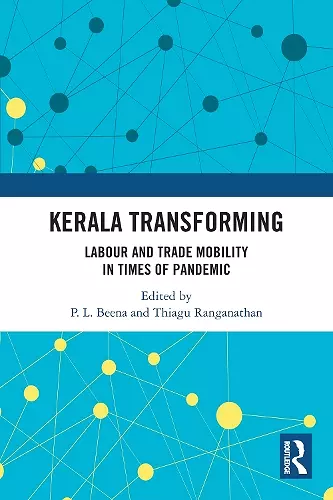
This book examines Kerala's recent development trajectory and highlights the impact of COVID-19 on its economy. It analyzes Kerala's growth and structural transformation while engaging critically with issues related to employment and migration. The book delves into policies aimed at reintegrating return migrants into Kerala’s development process. It examines the implications of Free Trade Agreements and policies initiated by the Government of India under the WTO regime on agriculture. The chapters in the book also investigate the impact of the growth trajectories on distributional aspects of inequality and social mobility.
Timely and topical, the book will be an indispensable resource for students and researchers of economics, development studies, trade, labour and migration, political economy, Kerala economy, and South Asian studies.
"This volume, analyzing the Kerala situation with a special focus on the manufacturing sector from a historical and sociological perspective, is much-needed, timely, and relevant. This book, impressively edited by Beena P. L. and Thiagu Ranganathan, explains quite well how the accumulated “human capital,” an educated and healthy population, which includes youngsters who obtain high-paying jobs abroad and send home remittances that the state invests in the services and manufacturing sectors. That said, it could have addressed the demographic situation with an ageing population and the declining numbers in the workforce (equivalent to that in highly developed countries such as those in Scandinavia), but in a relatively poor country."
Joseph TharamangalamProfessor Emeritus, Department of Sociology and Anthropology,
Mount St. Vincent University, Halifax, Canada
"Beyond doubt, the COVID-19 global pandemic affected all countries. However, studies focusing on its impact on subnational economies are few, especially in India, which makes this book of selected essays a useful contribution. Focusing on the Kerala economy set against its rather fast pace of transition resulting from its significant international labour migration and the consequent flow of remittances, the studies provide several lessons on understanding and facing such exogenous shocks as the COVID-19."
K. P. KannanChairman, Laurie Baker Centre and COSTFORD
Former Director and Honorary Fellow, Centre for Development Studies, Thiruvananthapuram
"For more than half a century now Kerala’s development experience has attracted scholarly attention. It continues to be a fertile and fascinating field of study. Labour and trade mobility from and to Kerala has a long and rich tradition the economic implications of which still remains an inadequately explored area. The collection of 13 papers in this book ably edited by Beena and Ranganathan is indeed a useful collection that will contribute to the scholarship this area that needs more work in greater depth."
M A OommenHonorary Fellow, Centre for Development Studies, Trivandrum
Distinguished Fellow, Gulati Institute of Finance and Taxation, Trivandrum &
Emeritus Professor, Institute of Management in Government, Trivandrum
"Labour and trade mobility influence regional development and human well-being, vis-à-vis migration, innovation, competitiveness, and skills development. This volume makes a compelling case for addressing Kerala’s economic growth through industrialization and public sector involvement. The contributions highlight Kerala’s structural transformation from agriculture to services outpacing the rest of India and the need for new paradigms, as multiple labour mobilities increase costs, risks, and vulnerabilities. As Kerala’s unique labour market dynamics – the outflux of educated natives and the influx of less-educated migrants – poses new economic and social dilemmas, many relevant findings in this book reassert the need to focus on higher occupational mobility to manage professionals across sectors and adapt to changing demands."
Shoba ArunReader, Work and Organisation Studies, Essex Business SchoolDirector, Internationalisation and Partnerships (Education)Associate Director, PGR (OSHRM), Essex Business School
"This volume, analyzing the Kerala situation with a special focus on the manufacturing sector from a historical and sociological perspective, is much-needed, timely, and relevant. This book, impressively edited by Beena P. L. and Thiagu Ranganathan, explains quite well how the accumulated “human capital,” an educated and healthy population, which includes youngsters who obtain high-paying jobs abroad and send home remittances that the state invests in the services and manufacturing sectors. That said, it could have addressed the demographic situation with an ageing population and the declining numbers in the workforce (equivalent to that in highly developed countries such as those in Scandinavia), but in a relatively poor country."
Joseph TharamangalamProfessor Emeritus, Department of Sociology and Anthropology,
Mount St. Vincent University, Halifax, Canada
"Beyond doubt, the COVID-19 global pandemic affected all countries. However, studies focusing on its impact on subnational economies are few, especially in India, which makes this book of selected essays a useful contribution. Focusing on the Kerala economy set against its rather fast pace of transition resulting from its significant international labour migration and the consequent flow of remittances, the studies provide several lessons on understanding and facing such exogenous shocks as the COVID-19."
K. P. KannanChairman, Laurie Baker Centre and COSTFORD
Former Director and Honorary Fellow, Centre for Development Studies, Thiruvananthapuram
"For more than half a century now Kerala’s development experience has attracted scholarly attention. It continues to be a fertile and fascinating field of study. Labour and trade mobility from and to Kerala has a long and rich tradition the economic implications of which still remains an inadequately explored area. The collection of 13 papers in this book ably edited by Beena and Ranganathan is indeed a useful collection that will contribute to the scholarship this area that needs more work in greater depth."
M A OommenHonorary Fellow, Centre for Development Studies, Trivandrum
Distinguished Fellow, Gulati Institute of Finance and Taxation, Trivandrum &
Emeritus Professor, Institute of Management in Government, Trivandrum
"Labour and trade mobility influence regional development and human well-being, vis-à-vis migration, innovation, competitiveness, and skills development. This volume makes a compelling case for addressing Kerala’s economic growth through industrialization and public sector involvement. The contributions highlight Kerala’s structural transformation from agriculture to services outpacing the rest of India and the need for new paradigms, as multiple labour mobilities increase costs, risks, and vulnerabilities. As Kerala’s unique labour market dynamics – the outflux of educated natives and the influx of less-educated migrants – poses new economic and social dilemmas, many relevant findings in this book reassert the need to focus on higher occupational mobility to manage professionals across sectors and adapt to changing demands."
Shoba ArunReader, Work and Organisation Studies, Essex Business SchoolDirector, Internationalisation and Partnerships (Education)Associate Director, PGR (OSHRM), Essex Business School
ISBN: 9781032539010
Dimensions: unknown
Weight: 700g
270 pages