Feminist Governance and International Law
A Critical Legal History from Mandate Palestine
Format:Hardback
Publisher:Taylor & Francis Ltd
Published:26th Sep '25
Should be back in stock very soon
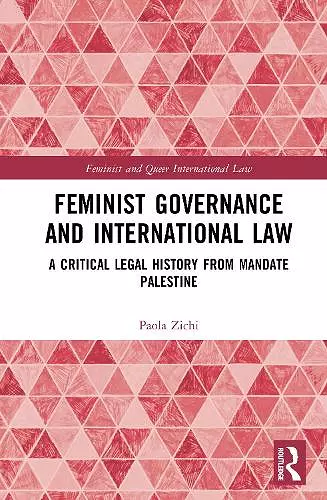
Documenting the intertwined history of international institutions and transnational feminism through the lens of Mandate Palestine in the inter-war period, this book elicits the historical formation of an early form of feminist governance at the international level. It is commonly accepted that ‘International Women’s Rights’ entered the halls of international institutions with the 1979 passage of the Convention on the Elimination of Discrimination Against Women. But as this book argues, feminist interventions in international law began much earlier. Engaging the history of feminist engagements with the first international institution of modern international law, the League of Nations, this book – based on archival research and drawing upon TWAIL and critical legal feminist approaches – focuses on the Arab-Palestinian feminist movement. Uncovering a peripheral feminist legal agenda, driven by women under colonial rule, the book interrogates feminist legal advances in three different fields: criminal and anti-trafficking laws, family and divorce laws, and human rights and prisoners’ laws. Detailing this early feminist legal activism, the book demonstrates how today’s feminists’ mission, as enshrined in the UN Charter and subsequent conventions, are the by-product of a much longer history of colonial resistance and contestation. This book will be of considerable interest to scholars and researchers in the fields of international law, international history, women’s and feminist history, and feminist legal studies.
Winner of the SLSA Early Career Book Prize
'Within this text, Paola Zichi offers a theoretically informed history of legal activism taking place in relation to Mandatory Palestine within feminist groups on a broad range of international issues, including the civic and familial status of women (Chapter 2), penal law and coloniality (Chapter 3), and labour and criminal regulation relating to policing, domestic and sex work, and human trafficking (Chapter 4). Each topic is rich in historical detail and robust in terms of critical analysis, rendering the book invaluable to anyone concerned not only with Palestine's particular history but also with how international law has, at various points, interacted with marginalised groups so as to complicate (and often frustrate) their collective and individual self-determination. Chapter 5, which takes a comparative view, is particularly fine in this regard, while Chapter 4 presents an important cautionary tale for how even well-meaning international efforts at ‘feminising politics’ can shore up the colonial domination of subject peoples. The book to this extent represents the best tradition of critical scholarship: one which abjures unhelpful theoretical abstraction and delivers contextually rich, nuanced analysis, never shying away from identifying instances of ambiguity and contention.'
Alex Green, Modern Law Review
ISBN: 9781032568867
Dimensions: unknown
Weight: 600g
254 pages