The Cinema of Agnieszka Holland
Anger and Ethics
Format:Hardback
Publisher:Taylor & Francis Ltd
Published:19th Feb '26
Should be back in stock very soon
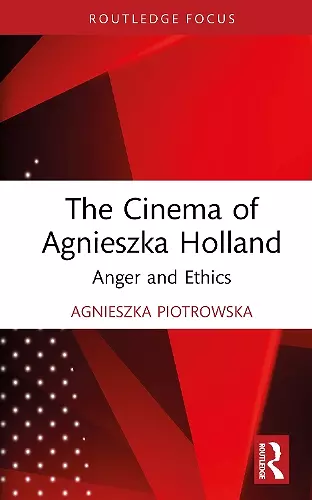
The Cinema of Agnieszka Holland: Anger and Ethics uniquely combines academic film analysis, biographical detail, and personal interviews with the filmmaker, conducted over the course of a year, to trace the development of Agnieszka Holland’s female characters and how they have been reshaped across half a century.
Piotrowska considers Holland’s distinctive and evolving vision of society, history, gender, and family relationships, with particular attention to how the filmmaker’s own background has influenced this vision. The study engages with Freud’s notion of afterwardness, Marianne Hirsch’s concept of posthistory, and the author’s theorisations of female authorship and the figure of the “nasty woman” in cinema. Through detailed readings of six feature films, it highlights Holland’s extraordinary contribution to global film and television culture, and her movement from despair to a creative rage through collaborations and adaptations.
This original and insightful work will be essential reading for students and scholars of European and world cinema, feminism, gender studies, European history, filmmaking, authorship, and applied psychoanalysis and ethics.
"This beautiful and inspirational work on Agnieszka Holland is a personal project for both author and filmmaker. Agnieszka Piotrowska draws on a stunning array of previously unseen photographs from Holland’s family album and personal archive, and sets these in a context that is culturally, historically and theoretically feminist. Drawing on interviews, recollections and analysis, this is a long overdue investigation - and celebration - of the work of this important filmmaker along her creative and political journey."
-- Lucy Bolton, Professor of Film Studies and Film Philosophy, Queen Mary University
"Agnieszka Piotrowska’s ground-breaking and highly original study of Holland’s film-making is also a study of the position of women in Poland as it emerged from communism, as well as Holland’s own journey as a film maker in the male dominated world of film-making in Eastern Europe and world wide where she was ‘praised for her "masculine" filmmaking whilst encountering gender-based limitations. Piotrowska draws on psychoanalysis to understand the choices made by Holland in her films and those of her characters, notably in Bitter Harvest which Holland spoke of as "a meditation on an impossible love, where trauma and intimacy become inextricably bound." Drawing on her extensive interviews with Holland and her detailed analysis of Holland’s films, Piotrowska demonstrates the importance for Holland ‘of creating meaningful connections beyond national, cultural, or familial boundaries …. suggesting the possibility of human solidarity in the face of nationalist division. Most of all, Piotrowska makes a very forceful case for revisiting Holland’s early films, and for the importance of her most recent ones that ‘offer no easy comfort’ but which suggest ‘that meaning can be created through acts of care and recognition’."
--Elizabeth Cowie, Professor Emeritus of Film Studies, University of Kent
"Agnieszka Piotrowska, writer, filmmaker, and psychoanalytic life coach, explores in this work areas rarely addressed by interpreters of Agnieszka Holland’s oeuvre. The book offers a valuable psychoanalytic perspective, presenting the artist and her work in relation to the history of her homeland, Poland, to growing up under communism, but also to private narratives and to complex family and social relationships. The Agnieszka Holland we know, an outstanding, versatile artist and also one of the most important female voices in the cinematic art of the twentieth and twenty-first centuries, emerges in Piotrowska’s account as a many-hued figure, still open to new interpretation and reinterpretation, much like her fascinating body of work."
-- Lukasz Maciejewski, writer, film critic and festival curator, Krakow, Poland
"This volume is an unusual and important work, confirming Agnieszka Holland’s unique place in world cinema. It is fascinating to see how the author of this volume and the filmmaker have turned their complicated pasts into beautiful and instructive works of the imagination. Different forms require different modes of interpretation. Putting these ideas into constructive dialogue offers a magnificent way out of the darkness.”
-- Sandy Flitterman-Lewis, scholar and author of To Desire Differently: Feminism and the French Cinema
ISBN: 9781032593401
Dimensions: unknown
Weight: 320g
138 pages