American Antiblackness
Examining the Fields of Contemporary Racism
Joe R Feagin editor Philip Ewell editor
Format:Paperback
Publisher:Taylor & Francis Ltd
Publishing:21st Aug '26
£38.99
This title is due to be published on 21st August, and will be despatched as soon as possible.
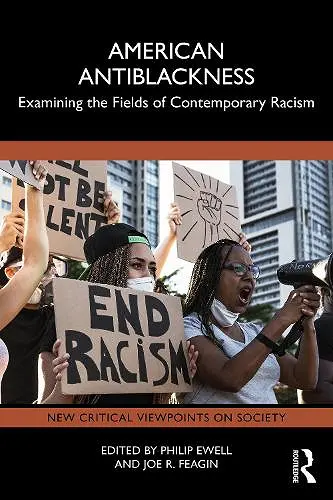
American Antiblackness: Examining the Fields of Contemporary Racism details how, from its founding, antiblackness has been axiomatic for the United States. The goal of antiblackness is the delegitimization and dehumanization of actual Blackness, from its oral and written resistance narratives to its outstanding works of literature and science, and from its hard-won political achievements to its strivings for greater freedom and social justice. This centuries-long process of delegitimization has racially segregated lives to a much larger extent than is generally acknowledged. This book provides a compelling window into how antiblackness is embedded, reproduced, and challenged in specific US organizations and institutions—including educational systems, sports leagues, STEM fields, and healthcare institutions. It foregrounds how many generations of Black activists and scholars have aggressively countered these racially discriminatory traditions.
Through a notable mix of established and rising scholars across numerous disciplines, American Antiblackness unpacks how antiblackness has been analyzed in many areas of research. This book presents an intersectional approach to understanding common debates and threads in how these various fields have examined antiblackness, and it will be of critical importance to social justice activists and scholars across many disciplines, including African American studies, the social sciences, the physical sciences, the humanities, public policy programs, and art and literature studies.
“This book addresses a vital topic of debate and offers a critically salient perspective on the political moment we are in. The editors are notable scholars of race and racism in higher education (and beyond), and they have assembled a volume that will be essential to scholars, students, and readers engaged in trying to understand the dynamics around race, systemic racism, anti-blackness, and the concomitant backlash(es) surrounding these issues.”
David G. Embrick, Professor of Sociology and Africana Studies, University of Connecticut
“American Antiblackness is a brilliant and powerful book which delves deeply and unsparingly into this four centuries-old phenomenon. Through the incisive contributions of leading scholars across different fields, Phil Ewell and Joe R. Feagin offer an unparalleled view into the pervasive structure, intentionality, and intersectionality of anti-blackness. As such, this important book is an indispensable resource for scholars and practitioners seeking to move forward on the pathway to greater social justice and inclusion.”
Edna Chun, Chief Learning Officer with HigherEd Talent, and instructor in the Human Capital Management Department of the Columbia University School of Professional Studies
“In American Antiblackness, Phil Ewell and Joe R. Feagin have assembled an impressive team of critical thinkers from a variety of academic and non-academic disciplines who argue convincingly that throughout its history anti-blackness has been at the core of American society and boldly challenge us to reimagine what this nation could be without it. Such acknowledgement and reimagining are especially needed today during this Trump-era of American race relations, the most intense and dangerous period of anti-blackness since Jim Crow.”
Noel A. Cazenave, Professor of Sociology, University of Connecticut, and author of Cazenave Eyes: Memories of Racism and Racism Studies
“American Antiblackness makes a bold statement that Americans must begin thinking very differently about race and racism in American society. The scholars who have contributed to this volume demonstrate that it is impossible to understand American intellectual thought without understanding the centrality of anti-blackness within it. To advance such thought, one must courageously confront and strive to eradicate the anti-blackness inherent within it. This work is not simply designed to be read, but to inspire action.”
Alford A. Young, Jr., Edgar G. Epps Collegiate Professor of Sociology, University of Michigan
“Phillip Ewell and Joe R. Feagin, leading race scholars from disciplines not commonly adjacent, have assembled a stellar cast of race scholars from diverse fields to address how antiblackness operates in their disciplines. American Antiblackness breaks new ground, broadening our understanding of antiblackness beyond our own academic niche and hopefully generating collaborations across fields. An excellent contribution, and a true must-read!”
Rogelio Sáenz, co-author of Latina/os in the United States: Diversity and Change
“Anti-Blackness functions like a many-headed hydra, rooted in racialized chattel slavery, private property, law, the political economy, racial capitalism, and everyday interactions. It cannot be reduced to individual bias or institutional failure; it is a durable system that has organized land, housing, wealth, labor, citizenship, and belonging by marking Black people’s quest for liberation as a threat to social order. Joe Feagin and his co-authors offer a powerful and necessary account of anti-Blackness, naming its constitutive parts while showing how they work together across time, location, and everyday life. This book provides a clear blueprint for understanding anti-Blackness as a unique social, historical, and political project that must be studied on its own terms, and Feagin has assembled the right people to lay this system bare.”
Waverly Duck, North Hall Endowed Chair of Sociology, University of California, Santa Barbara, author of No Way Out: Precarious Living in the Shadow of Poverty and Drug Dealing (2015), and co-author of Black Lives Matter: Ethnomethodological and Conversation Analytic Studies of Race and Systemic Racism in Everyday Interaction (Routledge, 2020)
ISBN: 9781032751115
Dimensions: unknown
Weight: unknown
356 pages