Self and Assemblage in Autoethnography
Memory, Place, and Solo Walking in Scotland and Australia
Format:Paperback
Publisher:Taylor & Francis Ltd
Publishing:7th Oct '26
£41.99
This title is due to be published on 7th October, and will be despatched as soon as possible.
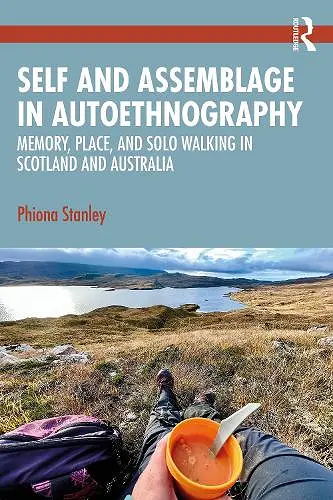
Self and Assemblage in Autoethnography offers a bold methodological provocation within qualitative research methods, advancing current debates in autoethnography by troubling the `auto' and arguing that the field must confront the sovereign, Enlightenment-derived self that it has inherited. Drawing on assemblage theory, feminist new materialism, and critical tourism geographies, the book proposes deep entanglements with place, memory, and materiality.
Set in the landscapes of Australia and Scotland, and grounded in solo hiking and wild camping, the book also contributes to cultural and tourism geographies by examining how settler narratives, contested land, and the politics of memory shape who gets to go outside, and how. Blending narrative, theory, and critique, it explores what it means to walk, remember, and write from within complex social and ecological assemblages, and what this all means for the practice and politics of autoethnographic research and writing.
Self and Assemblage in Autoethnography asks us to consider two questions. One is: what constitutes self and selves? Phiona Stanley’s answer challenges the unscrutinised assumptions about self and selfhood that lamentably inform much of the stuff currently labelled ‘autoethnographic’ writing. The other is, ‘what on earth is autoethnography?’ In answering this one, she re-writes the rules of the genre, taking it to a much higher level of complexity and sophistication. Both answers will, and should, trouble autoethnography’s current hugfest culture.
Professor Alec Grant,
Recipient of the International Conference of Autoethnography Lifetime Contribution Award
Is this book about trekking through wild, mostly uninhabited places — alternately delightful (awe-inspiring views, vibrant stars, clear singing streams) and horrifying (tortured histories, mucky bogs, blood-sucking parasites)? Or is it about the uncomfortable, inspiring, unsettling existential search for self? Or is it about writing autoethnography? It is all of these, and more. Stanley’s project, like life itself, offers no easy answers, no final destinations. Whether you think of your “self” as a stable being or as an ongoing project of agency bumping up against structure, or a relational or narrative accomplishment, or a manifestation of non-self, or a fluid assemblage, or some assemblage of all of these, you will surely find much food for thought in this wonder-filled adventure of a book. You’ll probably want to take it camping. And it will surely make you want to write.
Professor Christopher N. Poulos,
University of North Carolina
Self and Assemblage in Autoethnography is a pleasure to read from the outset. Its writing is sharp, witty, welcoming, smart. The author takes us with her on her journeyings across the world — within her homeland, Scotland, as well as to Latvia, northern Spain, the Arctic Circle, Australia, and more — and carrying us back and forth in time, provoking us to consider concepts and theory as she goes. The book is an enlivening reading experience, the author's stories told with energy and incisiveness, prompting us throughout to think and feel otherwise.
Professor Jonathan Wyatt,
University of Edinburgh
This is scholarship with such great traction, all the careful rocky way. Even when I felt some of my old foot-holds eroding or more abruptly helter-skeltering downhill I still had a sense of being held in a web of meaning-making that wasn't going to let any of us slip through the net. For those of us trained to approach knowledge-creation through unexamined colonial norms that rely on a bedrock of necropolitical values, this is not so much a breath of fresh air as a bracing invitation to choose life, to embrace un/knowing, to relearn to receive, to feel through the seas greens the clouds foamy alveoli and have done with binary-wrought violence and desecration.
Dr Lucy Aphramor, Radical Dietician and Poet, "Well Now"
ISBN: 9781032817323
Dimensions: unknown
Weight: unknown
148 pages