The Identity Reconstruction of Subaltern English Learners
Language, Liberation, and Leadership in South Asia
Nadeem Hussain author Aamir Hasan author
Format:Hardback
Publisher:Taylor & Francis Ltd
Published:17th Mar '26
£155.00
Supplier delay - available to order, but may take longer than usual.
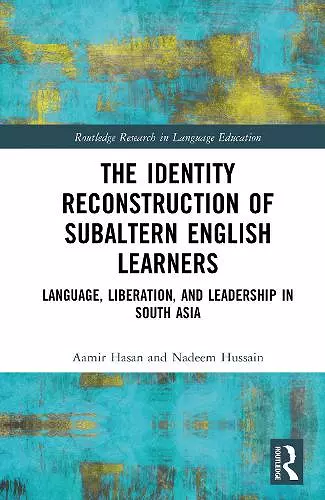
This book presents aqualitative study of language learners in the Global South who overcame insurmountable odds to acquire the English language. Drawing on rich data from successful non-elite, or Subaltern, learners, it explores the intersection of leadership development and English acquisition, documenting their identity reconstruction and metamorphosis.
The authors provide a detailed overview of the position of English in the modern world as well as the unique historical relationship between the language and South Asia. They then examine the determination of marginalized individuals to acquire English and introduce the term Liberative Motivation to define their desire to break out of restrictive class/caste-based silos. Filling a crucial gap in the narrative of English in South Asia, they explore the influence that English acquisition has on Subaltern identity, leadership, and self-esteem. The participants’ stories are deeply moving, demonstrating that for the Subaltern, dignity, respect, inclusion, and an educated identity are near impossibilities without knowing English. The authors propose the ‘Subaltern Self-Determination and English Acquisition Framework’ to encapsulate the interplay of factors in the Subaltern’s journey toward English, and they argue that the denial of English education borders on the denial of a basic human right in our present reality.
A unique account of the learning experiences of Subaltern populations, this book is an essential read for scholars, researchers, and postgraduate students with interests in Subaltern studies, English language acquisition, identity, and leadership, and human rights.
South Asian language activists who advocate displacing English in favor of indigenous languages should carefully consider the arguments presented in this important book. Else, they might betray the interests of the very people they fight for. Perhaps counterintuitively, the authors argue that English proficiency can actually enhance respect for and inject vitality into mother tongues. The book rightly insists that English is the primary language of science, research, and international communication, and those lacking facility in it cannot access an ever‑expanding repository of human wisdom and experience. For South Asian women who face limitations in terms of mobility, learning English is especially important. By investing in English acquisition, individuals can leverage ties to global knowledge for revitalizing society and enhancing their own social mobility.
Dr. Pervez Hoodbhoy, Ph.D. (MIT), Physicist and columnist
In this groundbreaking and deeply humane work, Hasan and Hussain illuminate how English acquisition becomes a powerful vehicle for social mobility, identity transformation, and leadership development among South Asia’s non‑elite popu‑ lations. Through rich narratives and careful analysis, they reveal how access to English has become inseparable from access to dignity, opportunity, and full participation in global society. This meticulously researched book makes an invaluable contribution to our understanding of language, power, and social justice – essential reading for educators, policymakers, and scholars interested in linguistic equity and social transformation in the Global South.
Dr. Carola Suarez-Orozco, HGSE
This book makes a persuasive case for learning and using English agentively by people in South Asia for their leadership and development efforts. The authors articulate how subaltern people can resist the hegemony of English from within by diversifying its norms and values for empowering purposes. They inspire us to engage in critical education and activism from their own experiences at the community level.
Dr. Suresh Canagarajah, Penn State
Through heart‑wrenching tales and razor‑sharp analyses, Hasan and Hussain offer a never‑before‑seen look into the fraught reality of learning English for the non‑elites in South Asia, whose struggles and triumphs constitute a powerful counter‑narrative to the often elitist position of undermining English under the banner of promoting mother tongues. Policy makers take heed!
Dr. Hansun Zhang Waring, Teachers College
In The Identity Reconstruction of Subaltern English Learners (2026), Hasan and Hussain offer a powerful reimagining of English language education in the Global South. Drawing on fieldwork across six South Asian countries, they chal‑ lenge deficit narratives and show how subaltern learners are reclaiming Eng‑ lish as a tool for resistance, dignity, and self‑determined leadership. Through community‑rooted pedagogies grounded in indigenous onto‑epistemologies, this work disrupts colonial hierarchies and centers belonging. A vital contribu‑ tion to decolonial and critical pedagogy, this book is essential for educators and policymakers envisioning English classrooms as a space of humanization, resist‑ ance, and radical hope.
Dr. Sarina Chugani Molina, University of San Diego
This is a beautifully written and ambitious book that provides a wide‑ranging account of the experiences of non‑elite learners of English from India, Bang‑ ladesh, Pakistan, Nepal, Afghanistan, and Sri Lanka. It shows powerfully the ways in which language is entangled with social structures and, specifically, how the use of English by elites in South Asia has served to reproduce inequalities by both caste and class. It will be of significant interest to scholars from a wide range of disciplines—including education, sociology, and youth studies.
Rachel Brooks (University of Oxford) President, British Sociological Association
In South Asia, millions of English learners without access to quality English education or environments for practice rely on their agency to learn the lan‑ guage. In doing so, they redefine their identities, fight for access to leadership, and dismantle the societal class structures that have long used English to main‑ tain privilege. In Hasan and Hussain’s rich qualitative analysis, we can hear the voices of subaltern, non‑elite individuals for whom learning English is far more than simply adding another language to their repertoire. While The Identity Reconstruction of Subaltern English Learners is a must‑read for specialists in sociology, linguistics, public policy, and development, many of its chapters are highly accessible and will be of interest to the general public.
Christina Sanz, Georgetown University
It may seem counterintuitive to argue that fluency in English is critical to the life chances of nonelite South Asians whose native languages are still the lin‑ gua franca of everyday life. In this volume, Hasan and Hussain skillfully trace the development of English language usage in South Asian settings, blending a macro historical account with interviews of aspiring leaders. They make the case that fluency in English is both the knowledge of the powerful and powerful knowledge. English opens doors of opportunity for non‑elites to exercise leader‑ ship and provides access to new ways of thinking that promote novel identities and positive self‑esteem.
Aaron M. Pallas, Dept. of Sociology, Colombia
The notion that acts of resistance are only possible by rejecting the English lan‑ guage fails to recognize that access to power is necessary for self‑emancipation and liberation. In this pathbreaking book, Hassan and Hussain detail colonial legacies of English and provide a powerful argument as to why access to Eng‑ lish is a basic human right in the South Asian context. Their discussion of lan‑ guage apartheid and why access to English promotes basic psychological needs Advance praise for The Identity Reconstruction of Subaltern English Learners Language, Liberation and Leadership in South Asia of competence, relatedness, and autonomy is a powerful lesson that applies globally.
Francesca Lopez, Ph.D., Distinguished Professor of Education
The Identity Reconstruction of Subaltern English Learners centers the lived experiences of South Asia’s most marginalized learners, those navigating the layered violences of caste, class, and coloniality in systems where English is both a barrier and a bridge. Through intimate, grounded narratives, this book traces how English acquisition can shift identity, open doors, and position people as leaders, even as it exposes the inequities of a language long used to reproduce dominance. It interrogates the educational structures that uphold exclusion and asks: What futures are possible when the subaltern must speak English to be heard? This is a call to reimagine language not only as a site of oppression but also as a powerful instrument of resistance and collective transformation.
Maria Cioe‑Pena, Ph.D., Assistant Professor of Education University of Pennsylvania
This book guides readers through the complexities of English acquisition in South Asia against the historical backdrop of colonization, segregation, and mar‑ ginalization. The careful analysis and stirring narratives of subaltern learners’ perseverance and success convincingly show that language can be an instrument of transformation and liberation, rather than oppression. The book serves as a powerful reminder that paths to equity rest on amplifying the voices of non‑elites and expanding their opportunities for leadership – goals hardly attainable as long as access to quality English education remains unequal and limited.
Nadja Tadic, Ed.D., Assistant Professor and Director of Undergraduate Studies, Georgetown University
A thought‑provoking study of the role that mastery of the English language plays in social and economic mobility in South Asia, authored by two scholars with deep research expertise and practical engagement in the region’s education and development sectors.
Charles James Kenny, Ph.D., Senior Fellow, Center for Global Development (CGD), Washington, D.C.
Hasan and Hussain offer a compelling account of how South Asia’s marginal‑ ized learners transform their identities and futures through English. The book’s innovative use of self‑determination theory and intersectional analysis high‑ lights the structural role of language, making it both theoretically rigorous and urgently relevant. By showing how access to English connects to public policy, leadership, and pathways of social and economic mobility, this work also speaks directly to broader debates on development and governance. It is an essential reading for anyone interested in language and the possibilities it creates for pro‑ gress in unequal societies.
Heath Rose, Ph.D., Professor of Applied Linguistics Department of Education, University of Oxford
Through vivid accounts of the voices and lived experiences of Subaltern learners—non‑elites excluded from dominant power structures in South Asia (India, Bangladesh, Pakistan, Nepal, Afghanistan, and Sri Lanka)—Aamir Hasan and Nadeem Hussain offer a compelling portrait of how English can become a vehicle of empowerment, a pathway to leadership, and a vital source of liberation, self‑esteem, and identity. Richly nuanced and genuinely humane, each narrative sheds fresh light on what it means to learn English, making this an inspiring and truly one‑of‑a‑kind work.
Yuko Goto Butler, Ph.D., Professor and Director of TESOL University of Pennsylvania
The Identity Reconstruction of Subaltern English Learners conducts a fas‑ cinating exploration of the role of the English language in disparity in South Asia. Hasan and Hussain eloquently trace out the linguistic contours of South Asian social hierarchy centralizing English as an inherited form of human capital both delimiting and determining status. Their qualitative analysis is careful, clear, fluidly written, and historically informed. In an era of both eco‑ nomic and unprecedented cultural globalization, the analysis is both timely and valuable.
Neil Cummins, Ph.D., Professor of Economic History London School of Economics and Political Science
This innovative volume reframes debates about English as a global language by centering subaltern perspectives from post‑colonial South Asia. Through first‑hand accounts and cross‑national case studies, the authors document how English mediates power, identity, and access in diverse local contexts. The book invites scholars, educators, and policy makers to rethink language policy and to prioritize the experiences of those most affected.
Anna De Fina, Ph.D., Professor of Linguistics, Georgetown University
Language Rights advocates around the world promote the rights of non‑ dominant language speakers to access education in their first language. In this outstanding book, Hasan and Hussain build on existing theoretical frameworks of self‑determination, identity, and liberation, and use rich data from in‑depth inter‑ views of non‑elites in South Asia to argue that access to English has become nec‑ essary to fully access dignity and opportunity. The achievements reached by the study’s participants—higher education degrees in various fields and high‑standing professional occupations around the world—required their mastery of English. Moreover, the authors argue that mastery in the dominant language was crucial to their sense of dignity. This book does not argue against instruction in non‑ dominant languages but rather that multilingualism with access to the language of power allows individuals to enhance respect for the mother tongue and advocate for the linguistic rights of non‑dominant language speakers.
Pierre de Galbert, Ed.D., Assistant Teaching Professor of Education, Brown University
This is a much‑needed study that casts light onto a very delicate and still often hid‑ den relationship, that of English as a tool of social class domination and discrimi‑ nation. By giving voice to South Asia subalterns as opposed to the elite embodied by the English‑speaking upper class, this book disentangles the intersectionality of leadership development and English acquisition providing the readers with pre‑ cious food for thought, making them reflect on all the deep implications that the knowledge of English has for non‑elite members in South Asian society. Tackling fundamental issues that pertain to dignity and self‑esteem, like the place of English in the Maslow pyramid of needs, and daring to ask whether English has become a basic human right, this book opens new perspectives in multiple fields of study, proving a trailblazing work that will guide reflection in many years to come.
Enrica Piccardo, Ph.D., Professor of Language Education University of Toronto
Language uses us as much as we use it. And the power of language to deter‑ mine and regulate one’s social positioning in the world is well documented. But what’s special about this book is how fully and carefully Hasan and Hussain dig into the ways in which English use in Southeast Asia is not only about com‑ munication and not just a legacy of previous systems of power, prestige, and exclusion—but is the very process by which personal and social identities of users are constructed and re‑constructed in context. Hats off to the authors for shining a nuanced light on language acquisition as empowerment for those con‑ sidered marginalized in the countries Hasan and Hussain investigate.
Brad Olsen, Ph.D., Senior Fellow – Global Economy and Development The Brookings Institution, Washington, D.C.
This book integrates rigorous policy analysis with rich life histories to show how language access is never neutral. In systems shaped by reform diffusion and mixed incentives, English becomes a site where power is contested and reconfig‑ ured. The authors document how subaltern learners claim dignity and leadership while also deepening commitment to mother tongues and local communities. It is a rare study that speaks to theory, method, and practice with equal clarity.
Mobarak Hossain, Ph.D., Assistant Professor of Social Policy London School of Economics and Political Science
In their book, Aamir Hasan and Nadeem Hussain challenge the melancholic narrative of the English language being imposed upon passive subaltern subjects across the globe. While certainly attentive to the (neo)colonial politics of Eng‑ lish, Hasan and Nadeem, through extensive research and illuminating commen‑ taries from South Asian English users, highlight that
ISBN: 9781032873367
Dimensions: unknown
Weight: 580g
196 pages