Inverse Design Methods for the Built Environment
Zhiqiang Zhai author Qingyan Chen author Xueyi You author Tengfei Zhang author
Format:Paperback
Publisher:Taylor & Francis Ltd
Published:14th Oct '24
Currently unavailable, and unfortunately no date known when it will be back
This paperback is available in another edition too:
- Hardback£171.99(9781138204980)
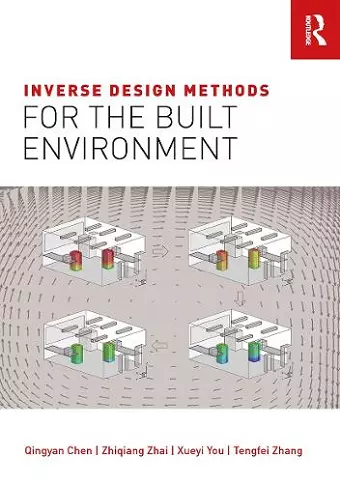
The inverse design approach is new to the built environment research and design community, though it has been used in other industries including automobile and airplane design. This book, from some of the pioneers of inverse design applications in the built environment, introduces the basic principles of inverse design and the specific techniques that can be applied to built environment systems. The authors' inverse design concept uses the desired enclosed environment as the design objective and inversely determines the systems required to achieve the objective.
The book discusses a number of backward and forward methods for inverse design. Backward methods, such as the quasi-reversibility method, the pseudo-reversibility method, and the regularized inverse matrix method, can be used to identify contaminant sources in an enclosed environment. However, these methods cannot be used to inversely design a desired indoor environment. Forward methods, such as the computational-fluid-dynamics (CFD)-based genetic algorithm (GA) method, the CFD-based adjoint method, the CFD-based artificial neural network (ANN) method, and the CFD-based proper orthogonal decomposition (POD) method, show the promise in the inverse design of airflow and heat transfer in an enclosed environment.
The book describes the fundamentals of the methods for beginners, provides exciting design examples for the reader to duplicate, discusses the pros and cons of each design method and points out the knowledge gaps for further development.
ISBN: 9781032924595
Dimensions: unknown
Weight: 540g
264 pages