Pandemics and Predicting the Probable
A Longitudinal and Mixed Methods Analysis of Covid-19 in Italy
Carmelo Lombardo author Maria Paola Faggiano author
Format:Hardback
Publisher:Taylor & Francis Ltd
Published:29th Apr '26
£155.00
Supplier delay - available to order, but may take longer than usual.
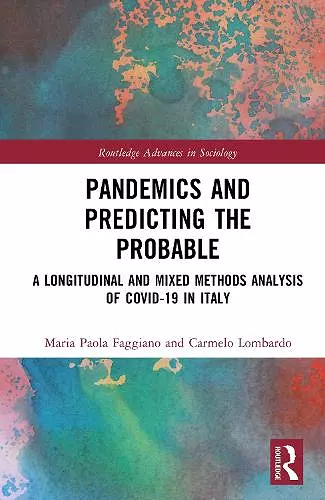
This book provides the first systematic, quali-quantitative examination of how perception, orientation, and anticipation of the future are produced and reproduced in disruptive times. Utilizing an extensive and assorted Italian data set, it revolves around the contemporary sociological discussion between subjective expectations and objective chances, showing how disadvantaged actors self-excluded themselves while facing ambiguous prospects during the Covid-19 pandemic.
Supported by both qualitative and quantitative evidence, the authors advance that structural, actual opportunities largely predetermine individual stances, especially while confronted with their post-pandemic hereafter – what Bourdieu calls “the causality of the probable”. Although a flood of publications ensued from the pandemic, many of which focused on the reproduction of inequalities taking place in such unsettled times, little or no attention has been paid to the dynamic through which social actors unequally envisioned future scenarios (as well as practical predispositions and adaptations to them), unevenly projecting themselves in the aftermath of the pandemic situation. Accordingly, this book interprets dispositions and attitudes toward the future of a national-scale sample of Italian subjects by highlighting to what extent these apperceptions are influenced by previous experiences, cultural schemas, and socioeconomic background.
An important contribution to the contemporary sociological discussion between subjective expectations and objective chances, it will appeal to researchers and scholars with interests in social reproduction, sociological theory, future studies, inequality, and mixed-method analysis.
ISBN: 9781032961194
Dimensions: unknown
Weight: 430g
134 pages