Nuclear Ecologies
Art and Collaboration in Post-3.11 Japan
Format:Paperback
Publisher:Taylor & Francis Ltd
Publishing:1st Sep '27
£35.99
This title is due to be published on 1st September, and will be despatched as soon as possible.
This paperback is available in another edition too:
- Hardback£171.99(9781032968025)
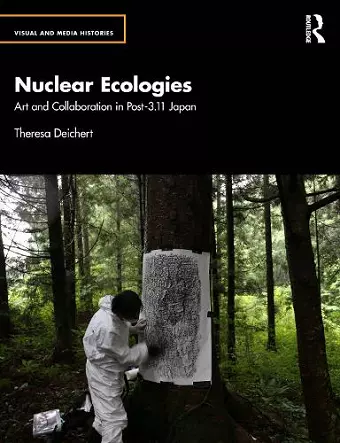
The Fukushima nuclear disaster of March 2011 left Japan grappling with profound social, political, and environmental consequences. Yet, in its wake, art emerged as a powerful response: artists turned to collaborative and ecological practices to make sense of the crisis, challenging official narratives and responding to the slow violence of radioactive contamination. This book examines how contemporary Japanese artists—among them Chim↑Pom, Kyun-Chome, Akira Takayama, Dokuyama Bontaro, Ei Arakawa-Nash, and others—have adopted strategies of collaboration that extend beyond the human, engaging with animals, plants, and even radioactivity itself as active agents in the artistic process.
Bringing ecological thought into conversation with transcultural art history, Nuclear Ecologies reconsiders collaboration not simply as a method of shared authorship, but as a distributed process shaped by complex networks of human and nonhuman agencies. Through close analysis of post-3.11 artworks, including site-specific projects within the Fukushima exclusion zone to participatory installations in Tokyo, the book explores how artists respond to, and are shaped by, local ecologies and the post-disaster politics of visibility and expression. Five in-depth case studies trace how artistic collaborations confront pressing post-disaster concerns: from radioactive contamination and structural inequalities to the lived realities of both human and nonhuman disaster victims.
Situating post-3.11 artistic practices within wider trajectories of socially engaged art and global art systems, this book—part of the Visual Media Histories series—challenges persistent boundaries between nature and culture, aesthetics and politics. It will be of interest to scholars and students in art history, Japanese studies, transcultural studies, environmental humanities, and those working across eco-aesthetics, posthumanism, and disaster studies.
'Nuclear Ecologies is a highly original study of how different collaborative artistic practices have addressed the Fukushima reactor meltdown to raise public awareness. In presenting this compelling model, Theresa Deichert argues that the current era of planetary precarity requires an ecological approach to the study of art in a de-centered network connecting humans, nonhumans, and the material environment.'
Claire Farago, Professor Emerita at the University of Colorado Boulder, United States, and author of Writing Borderless Histories of Art: Human Exceptionalism and the Climate Crisis
'Deichert lucidly analyzes how more-than-human collaboration and complex transculturation affectively constitute artistic responses to the 2011 triple disaster in Japan. From serving radioactive soup to exhibiting in the nuclear exclusion zone and connecting irradiated trees across Hiroshima and Fukushima - Nuclear Ecologies shows us less anthropocentric ways of being that are urgently needed.'
Franziska Koch, lecturer for Transcultural Studies at Heinrich-Heine University Düsseldorf, Germany
'Through employing an ‘ecological’ art historical research methodology decentering human agency, Deichert takes a fresh look at socio-politically engaged Japanese art. In five rich chapters, she adroitly contextualizes contemporary works of art within their social and cultural context, making a convincing case for a critical ecological engagement with art today.'
Hans-Martin Krämer, Professor of Japanese Studies and Dean of the Faculty of Humanities, Heidelberg University, Germany
ISBN: 9781032972442
Dimensions: unknown
Weight: unknown
282 pages