Digital Inclusion in an Unequal World
An Emancipatory Manifesto
Format:Paperback
Publisher:Taylor & Francis Ltd
Published:7th Apr '26
Should be back in stock very soon
This paperback is available in another edition too:
- Hardback£171.99(9781032983066)
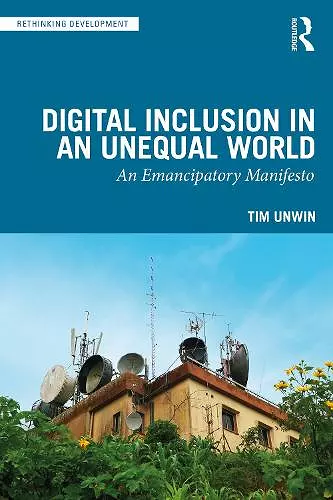
Why do so many attempts to use digital tech to help the world’s poor ultimately end in failure? Digital Inclusion in an Unequal World provides a detailed critique of previous theory and practice, while also proposing practical and realistic suggestions for good practice.
This book combines longer thematic chapters by Tim Unwin, one of the world’s leading thinkers on ICT for development, with shorter vignettes from other experts across a range of different practical, intellectual, and geographical backgrounds. The book argues that the global geo-politico-economic agendas associated with the use of digital tech in development in late-capitalism raise pressing issues around instrumentalism, individualism, and empowerment. This context drives short-termism and an innovation fetish around current hot topics, such as EdTech, Blockchain, and Artificial Intelligence. The world’s poorest and most marginalised people are failing to benefit from the use of digital technology, whilst the world’s Digital Barons continue to accrue profits. Unwin emphasises the importance of crafting a responsibilities agenda that will shift the dial, enabling practitioners to avoid common pitfalls and transform good intent into good practices.
This book is a highly readable guide for the global community of development practitioners, government officials, and civil society organisations involved in delivering digital tech initiatives. Students from the fields of international development, computer science, electronic engineering, geography, and economics will also benefit from its expert insights.
"Tim Unwin’s new book digs into some of the deep psychological reasons why our digital interventions so often fail to live up to the promise of being ‘for all’. He offers a sobering, even dystopian view of where things stand today—yet, at the same time, he inspires with his optimism that we still have the power to shape such technologies for real and lasting good."
Ralph Hertwig, Professor and Director of the Center for Adaptive Rationality, Max Planck Institute for Human Development, Berlin
"Tim’s diverse experiences have given him unique insights into what needs to be done so that the underprivileged and most marginalized population in Africa can really benefit from the use of digital tech. Used appropriately, digital tech can bring access to education, healthcare, financial services, and employment opportunities. It is an essential tool for social inclusion with the potential to reduce inequalities and foster sustainable development. This challenging book combines his practical experiences with rigorous scholarship to create a highly readable manifesto that cuts through the rhetoric and tells us all what we really need to do."
Helena Fernandes, Chairperson of the Board of Directors, Mozambique Communications Regulatory Authority (INCM)
"This new book raises alarms about really important matters. The gap in digital access and use is getting bigger, and the explicit intent for equality and equity in global initiatives is so rarely there. This powerful book resonates with many of my own concerns."
Haif Bannayan, Global Director Business Development, The International Baccalaureate
"I share with Tim a belief that we need to continue to do more to support the poorest and most marginalised individuals and communities in the world. What I do not share with him is his deep understanding of how digital tech can contribute to this effort, but equally how it can have profoundly harmful effects and deepen divisions and inequalities. As a result of reading this book, I am at least a little closer to that understanding, and hope that policy makers and those advising them will take careful note of its wise words and recommendations."
Sir Myles Wickstead, Visiting Professor, International Relations, and former senior civil servant and Ambassador
"Tim has articulated what many digital development advocates have long observed and privately lamented but seldom voiced publicly. In a world shaped by geopolitical tension, self-interest, and corporate exploitation, the gains of the technological revolution have reached only a privileged few. His book urges a return to compassion and reframes equity as an achievable goal. He critiques the corporate and political ecosystems, and makes an inspiring call for digital emancipation, laying out a clear roadmap for transformation, closing digital divides and unlocking opportunity for communities everywhere."
Bernadette Lewis, Secretary General, Commonwealth Telecommunications Organisation
"Digital transformation is having a major influence on the economy and the future of humanity, but many people in developing countries are still seeing only limited benefits. This important new book challenges us all to think again about how we can ensure that everyone benefits from the use of digital tech. Not only does it provide a sound critique, it also offers a clear manifesto for what we urgently need to do to rectify this."
Torbjörn Fredriksson, Head of E-commerce and Digital Economy, UNCTAD
"Tim has crossed many boundaries between academia, government service, international organisations, civil society and the private sector. This powerful and passionate book draws on his very extensive research practice to present a convincing case for why digital tech has not yet sufficiently been used to serve the world’s poorest and most marginalised. It also goes beyond this, and tells us clearly what we need to do to make the world fairer and less divided."
Chaesub Lee, Chairman of Passwordless Alliance and Principal Advisor of Welchmann Keen; formerly Director of ITU Telecommunication Standardization Bureau
ISBN: 9781032983042
Dimensions: unknown
Weight: 460g
226 pages