Epistemic Injustice and Resistance in Social Work
Rethinking Social Justice in Practice, Education, and Research
Eunjung Lee editor Andrea Greenblatt editor Ran Hu editor
Format:Paperback
Publisher:Taylor & Francis Ltd
Publishing:15th Sep '26
£35.99
This title is due to be published on 15th September, and will be despatched as soon as possible.
This paperback is available in another edition too:
- Hardback£150.00(9781041071464)
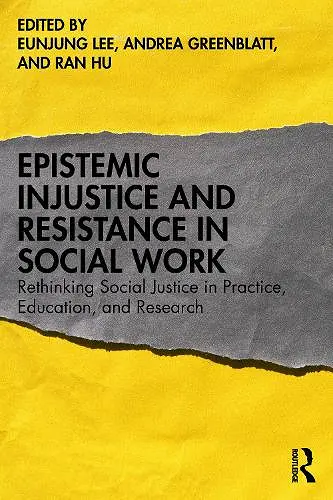
This book explores epistemic injustice in various aspects of social work practice, research, and education, and how those in the field can address issues of power, oppression, and institutionalized prejudice.
This edited volume invites social work scholars, educators, practitioners, and students to deeply engage in the conversation about social justice and human rights on epistemic grounds. It begins with a simple but profound question: Whose knowledge counts, and whose voices are silenced? Bridging the gap between theory and practice, this book contextualizes epistemic injustice concepts such as testimonial, hermeneutical, and contributory justice across diverse social work settings to help readers better recognize when and how these concepts manifest in the profession and how to address them from an epistemic justice lens. The chapters span a range of issues relevant to the field, including health and mental health, transformative social work, and the inclusion of systemically marginalized voices in practice and research such as LGBTQIA+, disabled communities, and street-involved. Contributors draw on their first-hand experience teaching social work students and practicing and researching with culturally diverse communities across settings. Each chapter invites readers to consider and reimagine ways of resisting epistemic injustice in their work and how social workers can join in collective resistance in the epistemic domains of the profession.
With case studies and practical examples throughout, this book is essential for social work students, educators, researchers, and practitioners of all levels. This guide serves both as a mirror to reflect the challenges within the profession and as a roadmap to chart pathways toward a more just, inclusive, and epistemically responsible field.
“As a philosopher, I found it fascinating to read these new employments of concepts of epistemic injustice in the sphere of social work—its theory and its practice. In their developments of theoretical ideas energized through application in a range of contexts and perspectives across professional social work, these contributions are testament to the practical power of abstract ideas.”
Miranda Fricker, Professor at New York University, USA and author of Epistemic Injustice: Power and the Ethics of Knowing
“Social work, even in its most radical versions, cannot claim to promote social justice without taking an honest look at its own assumptions. In particular, it must scrutinize the underlying processes of knowledge production. From multiple personal, political, and professional viewpoints, this collection powerfully invites us to do precisely that: to engage with uncomfortable questions that may unsettle the self-images of anti-oppressive and critical social work practitioners. Doing so enables us to open up important and timely avenues for revisiting and strengthening the emancipatory potential of the profession.”
Jasna Russo, Professor at Alice Salomon University of Applied Sciences, Berlin, Germany
“This timely and seminal volume offers a powerful exploration of what counts as knowledge for equitable and socially just social work. It should be essential reading for students, practitioners, and researchers seeking to understand what knowledge matters in social work and how it should be developed and applied in practice.”
Reima Ana Maglajlic, Reader in Social Work, Head of Department of Social Work and Social Care at University of Sussex, UK
ISBN: 9781041071440
Dimensions: unknown
Weight: unknown
276 pages