Mass Media Communication and Intersectional Crises
Gender, Climate, and Migration
Mirela Holy author Marija Geiger Zeman author Martina Topić-Rutherford author
Format:Paperback
Publisher:Taylor & Francis Ltd
Published:3rd Aug '26
£43.99
Supplier delay - available to order, but may take longer than usual.
This paperback is available in another edition too:
- Hardback£171.99(9781041085683)
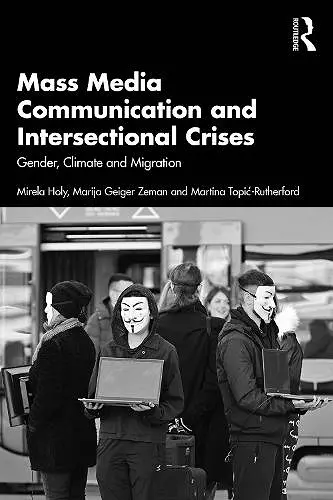
This book examines how contemporary global crises—climate change, migration, gender inequality, and economic precarity—are interconnected and shaped by communication, power, and representation.
Readers will gain a comprehensive understanding of how to analyse and communicate complex, intersectional crises through an innovative framework combining intersectional, feminist, postcolonial, and communication perspectives. The book delivers practical analytical tools by applying intersectionality to crisis studies, examining media representations and communication theories, and exploring both mainstream and grassroots responses to global challenges. Dedicated chapters on climate change, migration, digital technologies, and the gig economy demonstrate how to critically assess crisis communication while developing ethical approaches to media literacy. The book equips readers with both theoretical foundations and practical insights for understanding how crises are produced, experienced, and mediated across different contexts, emphasizing the political consequences of framing, visibility, and silence in crisis communication.
This book is written for students in communication studies, media studies, sociology, gender studies, and migration studies. It is also valuable for practitioners working in journalism, public relations, advocacy, and policy development. It provides both theoretical grounding and practical insights for analysing and communicating complex, intersectional crises responsibly.
“The world is in crisis, and communication is intrinsically linked to this persistent reality, and to the mitigation of its effects across axes of identity. In the preface to their textbook, authors Holy, Zeman, and Topić-Rutherford invite their readers to share in their commitment to “a more just, informed, and sustainable society.” Through the eight chapters of Mass Media Communication and Intersectional Crises, the authors expertly guide their reader through the global realities of concurrent, “deeply intertwined” crises, the confluent effects of which are increasingly vulnerable populations who experience subjectification by this global condition. Invoking the canonical theorizations of postcolonial theorists, from Said, and Spivak, to Bhabha, and the Black feminist grounding of intersectionality, these scholarly foundations are deftly deployed and extrapolated into the realms of the contemporary, proliferating crises of climate change, gender inequality and migration. While the book focuses on meaningful analyses of media narratives and a critique of the overlooked compounding intersectionality of these crises, the humanity of the chapters comes alive in the authors’ historical tracing of the tangible effects on specific vulnerable populations. With a purposeful balance of critical analysis and empathy for the individual and collective identities they describe, the reader comes away from this text with a deepened understanding of the discourses catalyzed through hegemonic injustice. Through critical lenses, like those of Hall and Hebdige, we are offered the hope of disrupting these intersectional crises through activism, empowerment, and social movements. For students of these grand narratives, step one may well be reading this book and completing the thought-provoking exercises within.”
- Susan McFarlane-Alvarez, Michigan State University, US
“After reading this powerful, important and timely book, it’s likely that you’ll look at climate change in a completely different way. Holy, Geiger Zeman and Topić-Rutherford deliver an excellently crafted and multi-layered text which expertly draws on intersectionality to critically understand current and pressing dilemmas around climate change. In particular, the ways in which climate change impact on migration, gendered and racialised groups, and armed conflict. By exploring this global problem, we begin to comprehensively understand its knock-on effect which affects us all. The book represents a call to action and outlines a variety of ways in which different actors can turn the tide, change the narrative, and help contribute towards a more equitable, just and fair future.”
- Daniel Kilvington, Leeds Beckett University, UK
“This book offers a timely, rigorous, and ethically grounded contribution to the study of mass media communication by placing gender, climate change, and migration firmly within an intersectional analytical framework. Through its sustained engagement with feminist, ecofeminist, and critical communication theories, it demonstrates with clarity that contemporary crises are not merely structural or environmental phenomena, but communicative processes shaped by power, representation, and inequality. The authors’ interdisciplinary approach, combined with empirical sensitivity and theoretical depth, makes this volume an essential resource for students, scholars, and practitioners seeking to understand how media narratives can both reproduce and challenge injustice. By foregrounding ethical responsibility, marginalised voices, and participatory communication, the book sets a standard for future scholarship in communication and media studies.”
- Ioannis Kostopoulos, Liverpool John Moores University, UK
ISBN: 9781041085669
Dimensions: unknown
Weight: 560g
284 pages