Philosophy of Artificial Intelligence
From Turing to Large Language Models
Donald Gillies author Marco Gillies author
Format:Paperback
Publisher:Taylor & Francis Ltd
Publishing:30th Sep '26
£41.99
This title is due to be published on 30th September, and will be despatched as soon as possible.
This paperback is available in another edition too:
- Hardback£155.00(9781041106227)
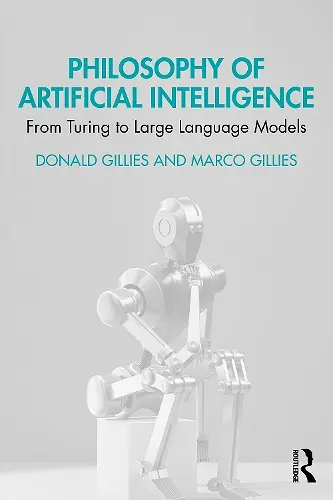
Artificial intelligence presents deep and important philosophical questions, ranging from whether computers can think, whether large language models truly understand language, and whether AI can be creative, to moral and political issues, criminal justice, health, and the future of work.
In this much-needed book, Donald and Marco Gillies, a philosopher and computer scientist respectively, introduce and examine some of these key topics in philosophy and science of AI, including:
- Alan Turing's imitation game and the beginnings of AI and expert systems.
- Induction and logic-based machine learning.
- Bayesianism and AI.
- The development of neural networks and deep learning.
- AI and moral issues, including social media and political radicalisation.
- Generative AI and the arts.
- Is an AI superintelligence possible?
- AI and the future of work.
Adopting a balanced historical and philosophical approach, Philosophy of Artificial Intelligence: From Turing to Large Language Models is ideal for those embarking on the study of this exciting topic, whether coming from philosophy or computer science. It provides a clear and engaging introduction to artificial intelligence.
'This is both a magnum opus reflecting deep scholarship, and also a jolly good read. Gillies and Gillies take us on a journey rooted in Alan Turing’s work, but reaching back to earlier philosophical insights and forward to the implications of current technology.' - Alan Dix, Cardiff Metropolitan University, and Swansea University, Wales, UK
'This book combines a rich account of the development of AI with a discussion of the main philosophical questions about AI. It sheds light on the close connections between AI and philosophy of science, and discusses topics such as creativity, explainability, the ethics of AI, existential threats and the threat of mass unemployment. This is essential reading for anyone wanting to understand the deeper implications of AI.' - Jon Williamson, University of Manchester, UK
'From its opening contention that Turing was a philosopher-mathematician like Descartes before him, to its discussions of the epistemology of machine learning, and the aesthetics and ethics of AI, this excellent book remains informative, thoughtful, and nuanced throughout. Gillies and Gillies clearly show how illuminating and productive the interaction between philosophy and artificial intelligence has been historically, and will continue to be.' - Professor Brian Ball, Computational Philosophy Lab, Northeastern University London
'This is both a magnum opus reflecting deep scholarship, and also a jolly good read. Gillies and Gillies take us on a journey rooted in Alan Turing’s work, but reaching back to earlier philosophical insights and forward to the implications of current technology.' - Alan Dix, Cardiff Metropolitan University, and Swansea University, Wales, UK
'This book combines a rich account of the development of AI with a discussion of the main philosophical questions about AI. It sheds light on the close connections between AI and philosophy of science, and discusses topics such as creativity, explainability, the ethics of AI, existential threats and the threat of mass unemployment. This is essential reading for anyone wanting to understand the deeper implications of AI.' - Jon Williamson, University of Manchester, UK
'From its opening contention that Turing was a philosopher-mathematician like Descartes before him, to its discussions of the epistemology of machine learning, and the aesthetics and ethics of AI, this excellent book remains informative, thoughtful, and nuanced throughout. Gillies and Gillies clearly show how illuminating and productive the interaction between philosophy and artificial intelligence has been historically, and will continue to be.' - Professor Brian Ball, Computational Philosophy Lab, Northeastern University London
ISBN: 9781041106210
Dimensions: unknown
Weight: unknown
18 pages