Every Molecule Matters
Format:Paperback
Publisher:Taylor & Francis Ltd
Published:9th Sep '25
Should be back in stock very soon
This paperback is available in another edition too:
- Hardback£96.99(9781041110637)
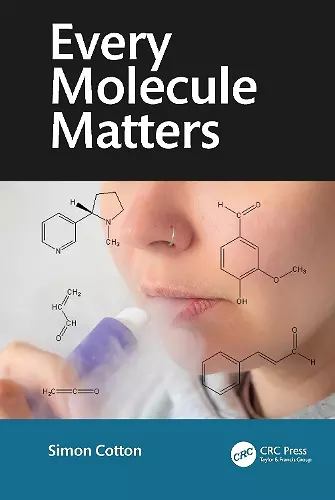
Every Molecule Matters is a successor to the author’s earlier Every Molecule Tells a Story and tells the story of a wide range of molecules.
These range from the familiar odours that enhance the pleasure of eating (and the spices that add piquancy) to the vitamins vital to our survival, as well as the ways in which insects and plants use chemicals to protect themselves. There’s controversy surrounding the compounds of chlorine, which encompass life‑supporting anaesthetics and natural antibiotics, as well as insecticides like DDT, which saved innumerable lives but became an environmental cause célèbre. Through the addictive power of nicotine, smoking tobacco transformed from a curiosity imported from the Americas into a megapound industry that has caused significant human illness and death. And how safe is vaping? Discover the painkillers that have become drugs of abuse, and smile at the smelly sulfur compounds that serve as unpleasant human odorants (and defence molecules for skunks), control natural cycles in the environment or act as flavourings in wine. You will discover them all here.
This book showcases the structures of hundreds of compounds used by humans, animals and plants. Some are beneficial; some are not. Find out here why you should be better informed about them.
- This collection of molecules includes human issues, such as the chemistry of vaping, and drugs of abuse, including ‘spice’, nitazenes and fentanyl
- ‘Chemistry of Everyday’ includes vitamins and the molecules that give foods their aromas and appetizing appeal
- The chemistry of nature ‑ how plants and insects use chemicals to defend themselves against potential predators, whether humans, birds, animals or other insects
- Organohalogen compounds, encompassing the atmosphere-damaging CFCs and their replacements, and the chlorine compounds that are important medicines (e.g. vancomycin)
- Using isotopes, from archaeologists faced by mysteries of ancient Rome and silver from Spanish conquistadors, to tracking down the origin of South American cocaine and solving the ‘Scissor Sister’ murder case <
In 2012, Simon Cotton, well-known for his work in chemistry and education, published a book entitled "Every Molecule Tells a Story." The author’s expressed audience was students and their teachers on both sides of “the pond.” His aim was to tell stories about the place of a wide range of chemicals in the context of society. Every Molecule Matters is a continuation of this story and contains, in many chapters, a rich historical background that would be of interest to readers of the Bulletin.
Every Molecule Matters is a user-friendly book right from the start. Its first two pages, placed even before the title and copyright pages, contain a précis of each of the book’s eleven chapters and alert the reader to the extensive bibliography (a treasure in its own right—containing books, primary source material, and some popular references) at the end. The chapters themselves cover virtually every type of human interaction with the chemical substances that surround us and are within us. Following a detailed table of contents, the first three chapters, on food, vitamins and spices, deal with molecules that we consume for nourishment, health maintenance, and tasteful pleasure. The next two chapters cover molecules of abuse and those that offend our sense of smell. The chapters that follow encompass nature’s chemical defense weapons, organochlorine and organofluorine compounds, smoking and vaping, isotopes and lastly, a discussion of a single important molecule, methane. Appropriately, every chapter is overflowing with the structural formulas necessary for understanding the many chemical reactions under discussion. However, every chapter also contains numerous historical references that are fine fodder for both teachers and other interested readers.
Examples of history abound in the first chapter on food in the form of allusions to times past: onions cultivated since the Bronze Age; the thousand-year history of tomato domestication by Central American farmers; the gene-editing of cultivated tomatoes to eliminate their original cucumber smell; the Roman poet, Ovid’s fascination with strawberries and the research by scientists such as Peter Schieberle on the more than 350 volatiles that give strawberries their flavor.
Cotton introduces his chapter on vitamins by noting ancient references to dietary deficiencies and the mid-19th century clinical trial that led to citrus fruits’ role in preventing scurvy. We also learn that it was Casimir Funk, a Polish biochemist who coined the word “vitamin” in 1912; that an American biochemist, Elmer McCollum, in 1916, differentiated them by using the capital letter system in use today; that the English biochemist Frederick Gowland Hopkins demonstrated that for growth animals needed unknown substances in addition to proteins, carbohydrates and lipids (Nobel Prize for Physiology or Medicine in 1929), and that Vitamin A was the first to be identified in 1920. The rich history of the B vitamins (thiamine, riboflavin, niacin, pantothenic acid, pyridoxine, folic acid and cobalamin), accompanied by five pages of references, follows. Then come historical thumbnails on Vitamin C (L-ascorbic acid), Vitamin D (calciferol), Vitamin E (the tocopherols) and Vitamin K, with an additional four pages of references. This chapter alone covers a good chunk of the history of biochemistry with much of the legwork done by the author.
If you want a concise history of spices with five pages of references, including material sorted according to important individual spice groups such as mustard, capsaicin, menthol, Szechuan peppers, chilies and curries, Chapter 3, “Hot and Cold,” provides it. The chapter opens with a brief description of the global human use of spices through the ages, beginning with the ancient Asians and moves westward to Egypt, the Greeks, the Romans and the 15th century explorers, with about 25 general references provided.
Both naturally occurring and synthetic drugs are introduced in their historical context in chapter 4, “Abused Painkillers and Other Drugs of Abuse.” Opium takes pride of place since its known use dates back to the second millennium BCE. Cotton takes the story of its use and abuse from there up until the present day and goes on to discuss its two close relatives, morphine and heroin. Then comes the 20th century purpose-synthesized, and now notorious, painkiller, fentanyl and its more toxic family members, carfentanil and remifentanil. The chapter closes with a treatise on semi-synthetic drugs, such as oxycodone and Krokodil, and the “Novel Psychoactive Substances” (NPS) such as “Spice,” that debuted in the first decade of the 21st century. A whopping six pages of references accompany the narrative.
The chapter called “Nasty-Smelling Molecules,” as might be expected, highlights the role of sulfur-containing molecules such as thiols (mercaptans) and dimethyl sulfide in our foods, in our homes, in our interactions with plants and animals, in our personal hygiene and in our
deaths. Bits of chemical history are scattered throughout the chapter, and six pages of references support it including one subheading that might give us pause: “Molecules and Human Remains.”
Chapter 6, “War and Peace in Nature,” is aptly named since it deals with chemical defense mechanisms in plants and animals, highlighting Mother Nature as a brilliant synthetic chemist. Plants manufacture toxins that protect them against insects; small insects are adept at synthesizing chemical defenses against larger predators. The chapter closes with a brief description of the history of compounds that serve as insect repellants. The bibliography is broken down into sections on “Green Aroma,” “Plant Defence,” and “Weaponized Insects,” of which there are not a few.
The history of organochlorine compounds, the subject of Chapter 7, is bound up with the development of pesticides such as DDT, Dieldrin, Aldrin, and chlorinated phenols, although the author makes it clear that the first successful synthetic organochlorine compounds were anesthetics. And we also learn that although organochlorine compounds have taken the rap for being notorious environmental pollutants introduced into the atmosphere through human activity, the amounts produced by natural sources far exceed those produced by industry. Surprise, surprise!
On the other hand, Chapter 8 compresses the relatively short synthetic history of organofluorine
compounds into 16 pages but accompanies them with a whopping 83 references under 13 subheadings, but documents only one naturally occurring organofluorine compound. This anomaly, sodium fluoroacetate, found in native Australian plants of the genus Gastrolobium, is toxic to introduced species but native species are immune. This differentiating feature makes it invaluable in the control of some forms of invasive species.
The chemistry of these compounds is driven by the properties of fluorine, the most active element known, and consequently, the most stable types of compounds known, giving rise to the soubriquet “forever compounds.” Initially thought to be a boon as stable, nontoxic refrigerants, their manufacture has been mostly banned in developed countries due to their environmental impact on the ozone layer and the food chain. Two famous chemists, Jean-Baptiste Dumas and Alexander Borodin, succeeded in preparing the first two organofluorine compounds: an aliphatic in 1835 and an aromatic in 1862. Their work preceded the actual isolation of the element itself in 1886 by Henri Moissan, for which he won the Nobel Prize in chemistry in 1906, beating out Dmitri Mendeleev by one vote. While Mendeleev is now a household name in the halls of chemistry, one can almost hear a student ask, “Henri who?” As if to place an exclamation point on the fact of Moissan’s disappearance in chemical history, this reviewer once visited his burial place in Père Lachaise Cemetery in Paris only to find the grave unmarked and totally grown over with weeds.
Chapter 9, “Smoking and Vaping,” deals with the myriad ways that humans have devised to deliver a single toxic, addictive chemical species, nicotine, into their bodies. The chapter begins with several pages of historical context and anecdotes highlighting nicotine’s toxicity. Then the chemistry of smoking and vaping are dealt with in turn. Smoking, the combustion and inhalation of a tobacco product, oxidizes about 90% of the nicotine into thousands of toxic chemicals, many of which are known carcinogens. The remaining 10%, once vaporized, can reach the brain via lungs and blood within a matter of seconds, where it has a half-life of about two hours. The exposure of the smoker to the combustion by-products leads to the smoking-related diseases that kill approximately 8 million people per annum. Since vaping releases nicotine into the body without its toxic combustion products, this method has been touted as a safer alternative to smoking. However, given the fact that heating the e-cigarette solvent can produce dangerous concentrations of aldehydes and other toxic compounds, vaping cannot be considered as harmless as licking a lollipop. At the very least, vaping, like smoking, predisposes young people to disease. Just some of the topic headings in the bibliography should give one pause: nicotine pharmacology and addiction, nicotine poisoning, green tobacco sickness, smoking and disease, toxic chemicals in tobacco smoke, nitrosamines, metal heating elements and metal pieces, solvents and acetals, aldehydes, diacetyl, nicotine analogues. Caveat fumator!
“Isotopes at Work,” the subject of Chapter 10, is not, strictly speaking, about molecules, but since isotopes are the building blocks of molecules and have a fascinating history, they are properly included. Physicists at Cambridge first recognized their existence in the early 20th century; this early work and the discovery of heavy water (deuterium oxide) garnered several Nobel prizes. Isotopes quickly became useful markers in such diverse areas as archaeology, determining reaction mechanisms, environmental pollution, coinage studies, food fraud, nuclear power, tracking synthetic drugs and solving crimes. Cotton includes some fascinating stories in each of these areas.
A single molecule, methane, is the subject of the final chapter. Naturally occurring in every sector of the universe, the major component of the fuel mainstay, natural gas, and yet one of the most potent of the greenhouse gases methane is a simple molecule of many faces. It figures in every phase of the human search for energy; it now lurks as a threat in melting permafrost. This single compound embodies all the progress and setbacks described in the prior ten chapters.
From start to finish, this book charts the fascinating intersection of the scientific mind and the human spirit with the materials that Mother Nature has put at their disposal. Some molecules newly discovered or uncovered were celebrated as a boon but soon had to be phased out or banned altogether because of their deleterious effects on health, the environment, or whatever. Others lived on as indispensable problem solvers or lifesaving pharmaceuticals. Along the way, we meet interesting and sometimes unfortunate characters like Rachel Carson, Paracelsus and King Richard III. Molecules inhabiting cheddar cheese, Chinese peppers and shiitake mushrooms spice up the scene. Wherever you place your finger or your bookmark, you will find an intriguing story to whet your appetite for more. For the dyed-in-the-wool chemist, structural formulas abound to clarify the text. And history thrums along in the background like the basso continuo of a Baroque concerto. Lectori omnia fruatur!
The book opens with a table of Contents, a Preface, an Overview of each chapter and a brief author biography. It concludes with a Bibliography and an Index.
Mary Virginia Orna
Professor Emerita of Chemistry,The College of New Rochelle
Review Published in The Bulletin for the History of
Chemistry, Volume 51, Number 1 (Pages 167-169).
I really did enjoy reading this book. The chapter on the abuse of painkillers is a highlight, and covers the history behind the use of opium and how it was used for everything from toothache to diarrhea before it became regulated, refined and then commercialized. This chapter sums up how a lot of medicines are introduced into society. It is fascinating to see how these substances can then be synthesized with huge benefits to society as in the case of anesthetics and analgesics, and this book does a great job of discussing both the benefits of drugs such as fentanyl, in palliative care but also its illicit use as the street drug, China white.
Dr. Cotton makes the chemistry come to life when discussing the history and synthesis of these drugs and others such as 'spice' and 'oxycodone' and how they have benefitted society as well as caused so much pain. Another standout is the chapter on 'Smoking and Vaping,' which will certainly be one that will be developed in the coming years. We are all aware of the harmful effects of smoking but it was the vaping section that was of particular interest. The addictive and harmful effects of nicotine have been known and so its use within e-cigarettes innately felt harmful, but the impact of heating the e-liquid, as explained in this book, is very worrying. In my professional capacity, I believe that warning about vaping will become a routine that we will be doing as more evidence comes to light.
"Every Molecule Matters" is an engrossing book, with lots of well researched history, and has made chemistry interesting and practical for the layperson. Every student would benefit from the practical use of chemistry in this book.
Kenny Mashru
BDS, Sheffield University, Sheffield, England
Overview
This compilation is an essential reference work for every chemist – particularly organic chemists. It is a handbook of up-to-date knowledge on many of the chemical compounds in our chemical world, and their contexts. Not only is each chapter full of fascinating facts, but each chapter examines the molecules from a different perspective. Here, this reviewer provides commentaries on each of the chapters.
Chapter 1: Food
What differentiates this book from others that cover the topic of food is that, upfront Dr. Cotton discusses the taste of foods: “So the core of this chapter is to consider molecules responsible for flavour sensations in a range of foods, both cooked and uncooked “. This topic is especially relevant to those who, through chemotherapy, or though viral infections, lose their ability to experience the food sensations.
According to Dr. Cotton, roast beef has been the most studied, the delightful smell (to most carnivores) coming primarily from: methiona
ISBN: 9781041110620
Dimensions: unknown
Weight: 540g
296 pages