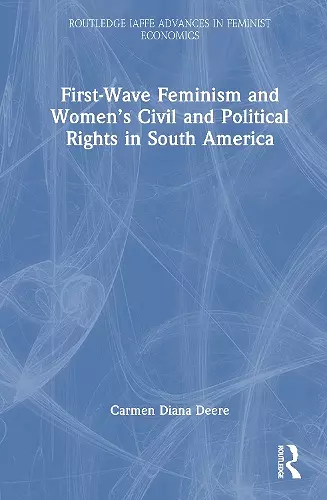
First-Wave Feminism and Women’s Civil and Political Rights in South America
Format:Hardback
Publisher:Taylor & Francis Ltd
Published:18th Dec '25
Currently unavailable, and unfortunately no date known when it will be back
This hardback is available in another edition too:
- Paperback£55.99(9781041111306)
This book analyzes the context, process and content of the reform of married women’s property rights in seven Spanish-speaking South American countries – Argentina, Chile, Colombia, Ecuador, Peru, Uruguay and Venezuela – between 1900 and the early 1950s.
It investigates how the reforms enacted earlier in the United States, England and continental Europe and national antecedents and conditions informed the ideas of feminists, jurists and politicians and shows how their interaction influenced the content of the reforms attained. It highlights the role of feminists and their organizations in achieving stronger property rights, emphasizing their proposals to reform the civil code. The book argues that while most feminists framed their arguments in maternalist terms – that they needed stronger rights to be better wives and mothers – their proposals to reform the marital regime fell along a continuum that ranged from accepting the husband as sole household head to gender equality in marriage. Since the long-run goal was to attain equal civil and political rights, the book also demonstrates how these two demands for stronger property rights and suffrage influenced their strategies and what feminists were able to achieve.
This book contributes to a long-standing discussion on the relationship between socioeconomic and legal change and brings the findings of recent scholarship and a vast array of primary materials only available in Spanish to an English-speaking audience, interpreting legal concepts and debates in a manner accessible to social scientists. Written from an interdisciplinary perspective, it supports the construction of a feminist legal history of marital regimes. It will be of interest to historians, legal scholars and feminists across a range of disciplines.
Cover image: Reception hosted by Feminismo Peruano Z.A.C. for members of the Inter-American Commission on Women attending the Eighth International Conference of American States in Lima, 1938. Courtesy of Schlesinger Library, Harvard Radcliffe Institute.
“This ambitious book compares the movements to reform women’s legal status over half a century in seven South American countries. Its broad comparative approach challenges many facile generalizations about Latin American legal and women’s history. A truly impressive achievement.” — Silvia Arrom, Jane's Professor of Latin American Studies Emerita, Brandeis University, U.S.A.
“Carmen Diana Deere's work represents an excellent and necessary input for research and teaching from a gender and feminist perspective in the field of social sciences, especially for feminist economists in Latin America. Until now, we did not have material that informed us about this topic in historical and comparative terms for a large part of the region. Likewise, the work is essential to understand the relationship between feminist demands, maternalism, and social, political and economic contexts.” — Alma Espino, President of the Interdisciplinary Center for Development Studies of Uruguay (CIEDUR).
“This ambitious book compares the movements to reform women’s legal status over half a century in seven South American countries. Its broad comparative approach challenges many facile generalizations about Latin American legal and women’s history. A truly impressive achievement.” — Silvia Arrom, Jane's Professor of Latin American Studies Emerita, Brandeis University, U.S.A.
“Carmen Diana Deere's work represents an excellent and necessary input for research and teaching from a gender and feminist perspective in the field of social sciences, especially for feminist economists in Latin America. Until now, we did not have material that informed us about this topic in historical and comparative terms for a large part of the region. Likewise, the work is essential to understand the relationship between feminist demands, maternalism, and social, political and economic contexts.” — Alma Espino, President of the Interdisciplinary Center for Development Studies of Uruguay (CIEDUR).
ISBN: 9781041111313
Dimensions: unknown
Weight: 880g
368 pages