Reading Freud’s Beyond the Pleasure Principle
Trauma and Life
Format:Paperback
Publisher:Taylor & Francis Ltd
Published:3rd Jul '26
Should be back in stock very soon
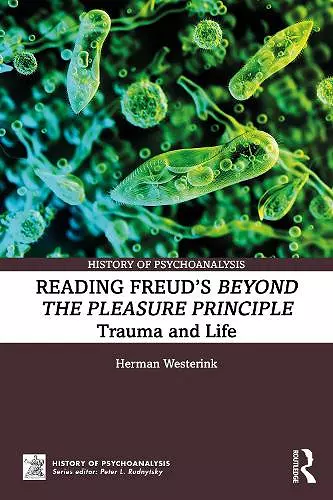
Reading Freud’s Beyond the Pleasure Principle presents a new reading of this foundational text, based on the hypothesis that the work was written in two phases.
Herman Westerink explores the idea that Freud put the first version of 1919 aside because he found the conclusions he drew from his line of reasoning difficult if not impossible to accept. The book considers which clinical and theoretical problems Freud wanted to address in the first version of the text, what arguments he developed, and in what way these explorations and arguments resulted in implications he considered problematic. Returning to the text in 1920, Westerink asserts that Freud introduced theories of the life and death drives as a response and possible solution to the problems and implications of his 1919 inquiries.
Reading Freud’s Beyond the Pleasure Principle will be a significant reference for academics and scholars of Freud, psychoanalytic studies, trauma, critical theory, philosophy and the history of science. It will be of great interest to psychoanalysts in practice and in training.
“Challenging one-dimensional readings of Freud’s Beyond the Pleasure Principle, this book builds on the finding that the text was composed in two stages (1919–1920), each articulating distinct theoretical constructions around its central concepts—the life drives and the death drives—as they relate to trauma. With clarity and originality, the book traces the elaboration of these theories and their complex interplay across biophysics, biology, and evolutionary thought. The result is a nuanced and illuminating study that deepens our understanding of the conceptual architecture of psychoanalytic theory.” - Ulrike Kistner, Emiritus Professor of Philosophy, University of Pretoria, South Africa
“Reading Freud’s Beyond the Pleasure Principle is a sweeping endeavour. Taking up the original argument developed in his coauthored Seduction, Drive and Repetition (2025) concerning the persistence of trauma—including seduction—in Freud’s conception of transference neuroses, Westerink turns here to the two strikingly different versions of Freud’s Beyond the Pleasure Principle (1919 and 1920). Covering works from Freud’s 1895-1896 Project through his late group psychology, he follows the evolution of the drives in Freud and traces the genealogy of the pleasure and reality principles down to Freud’s ultimate theory of life versus death drives (43). Following the model of trauma inaugurated by the clinic of hysteria, Freud’s analytic work gradually turns to a “pathoanalysis of human existence.” Striving to adapt German Darwinism (Haeckel’s recapitulation theory), what begins as a study of the evolutionary stages of sexuality moves toward a much broader, philogenetically inherited scheme (97), whose ambition is to make psychoanalysis an authentic, genetic, anthropology. Throughout his arguments, Westerink shows how Freud integrated materialist mechanism (Helmholtz), Darwinism and its variants, biology, and physics into a conception of the history and fundamental interrelatedness of organic substances—in short, of life itself. In the process, the meaning of consciousness is reconceived (106) and the cellular theory of his time reframed in such a way that the famous hiatus between the physical and the psychic emerges as a metabiology and a recoceived dualism. This book is thus vastly more than a study of Beyond the Pleasure Principle. It is a crucial odyssey through the history of decisive sciences in the late nineteenth century and beyond. Avoiding the traps of organicism and vitalism, it is a map of a new philosophy of life. Westerink proceeds from long years of psychoanalytic study, practice, and collaboration. His work with Philippe Van Haute on sexuality and trauma make Westerink a foremost authority both in critical Freudian studies and henceforth in the history of science.” - B. Bergo, Professor of Philosophy, University of Montreal, Canada
“This book creates a fresh and polysemic space for re-encountering Freud’s Beyond the Pleasure Principle. Herman Westerink subtly and compellingly recalibrates the Freudian text to contemporary debates, while rigorously unpacking the plural field of Freud’s influences and affinities. Avoiding any attempt to harmonise this event-text, Herman Westerink inhabits its contradictions with striking precision but also with excitement for Freud’s speculative thinking. Ultimately, this book takes psychoanalysis seriously in its clinical anthropology dimension and it shows, through Freud’s text, the unique potential that psychoanalysis has in rethinking biology. Herman Westerink offers brilliant insights into Freud’s curiosity about the traumatic character of the origin of life. Freud emerges as a thinker of catastrophes, while Beyond the Pleasure Principle emerges as the site of not one, but several drive theories. This volume will produce an important mark in both psychoanalytic and philosophical debates.” - Raluca Soreanu, Psychoanalyst & Professor of Psychoanalytic Studies, University of Essex, UK
“Challenging one-dimensional readings of Freud’s Beyond the Pleasure Principle, this book builds on the finding that the text was composed in two stages (1919–1920), each articulating distinct theoretical constructions around its central concepts—the life drives and the death drives—as they relate to trauma. With clarity and originality, the book traces the elaboration of these theories and their complex interplay across biophysics, biology, and evolutionary thought. The result is a nuanced and illuminating study that deepens our understanding of the conceptual architecture of psychoanalytic theory.” - Ulrike Kistner, Emiritus Professor of Philosophy, University of Pretoria, South Africa
“Reading Freud’s Beyond the Pleasure Principle is a sweeping endeavour. Taking up the original argument developed in his coauthored Seduction, Drive and Repetition (2025) concerning the persistence of trauma—including seduction—in Freud’s conception of transference neuroses, Westerink turns here to the two strikingly different versions of Freud’s Beyond the Pleasure Principle (1919 and 1920). Covering works from Freud’s 1895-1896 Project through his late group psychology, he follows the evolution of the drives in Freud and traces the genealogy of the pleasure and reality principles down to Freud’s ultimate theory of life versus death drives (43). Following the model of trauma inaugurated by the clinic of hysteria, Freud’s analytic work gradually turns to a “pathoanalysis of human existence.” Striving to adapt German Darwinism (Haeckel’s recapitulation theory), what begins as a study of the evolutionary stages of sexuality moves toward a much broader, philogenetically inherited scheme (97), whose ambition is to make psychoanalysis an authentic, genetic, anthropology. Throughout his arguments, Westerink shows how Freud integrated materialist mechanism (Helmholtz), Darwinism and its variants, biology, and physics into a conception of the history and fundamental interrelatedness of organic substances—in short, of life itself. In the process, the meaning of consciousness is reconceived (106) and the cellular theory of his time reframed in such a way that the famous hiatus between the physical and the psychic emerges as a metabiology and a recoceived dualism. This book is thus vastly more than a study of Beyond the Pleasure Principle. It is a crucial odyssey through the history of decisive sciences in the late nineteenth century and beyond. Avoiding the traps of organicism and vitalism, it is a map of a new philosophy of life. Westerink proceeds from long years of psychoanalytic study, practice, and collaboration. His work with Philippe Van Haute on sexuality and trauma make Westerink a foremost authority both in critical Freudian studies and henceforth in the history of science.” - B. Bergo, Professor of Philosophy, University of Montreal, Canada
“This book creates a fresh and polysemic space for re-encountering Freud’s Beyond the Pleasure Principle. Herman Westerink subtly and compellingly recalibrates the Freudian text to contemporary debates, while rigorously unpacking the plural field of Freud’s influences and affinities. Avoiding any attempt to harmonise this event-text, Herman Westerink inhabits its contradictions with striking precision but also with excitement for Freud’s speculative thinking. Ultimately, this book takes psychoanalysis seriously in its clinical anthropology dimension and it shows, through Freud’s text, the unique potential that psychoanalysis has in rethinking biology. Herman Westerink offers brilliant insights into Freud’s curiosity about the traumatic character of the origin of life. Freud emerges as a thinker of catastrophes, while Beyond the Pleasure Principle emerges as the site of not one, but several drive theories. This volume will produce an important mark in both psychoanalytic and philosophical debates.” - Raluca Soreanu, Psychoanalyst & Professor of Psychoanalytic Studies, University of Essex, UK
ISBN: 9781041156222
Dimensions: unknown
Weight: 360g
200 pages