Art and Ocean Objects of Early Modern Eurasia
Shells, Bodies, and Materiality
Format:Paperback
Publisher:Taylor & Francis Ltd
Published:1st Dec '25
Currently unavailable, and unfortunately no date known when it will be back
This paperback is available in another edition too:
- Hardback£145.99(9789463721158)
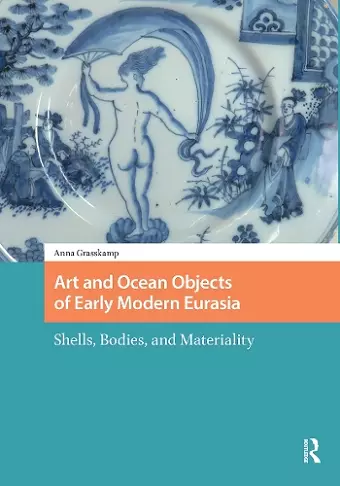
During the early modern period, objects of maritime material culture were removed from their places of origin and traded, collected and displayed worldwide. Focusing on shells and pearls exchanged within local and global networks, this monograph compares and connects Asian, in particular Chinese, and European practices of oceanic exploitation in the framework of a transcultural history of art with an understanding of maritime material culture as gendered. Perceiving the ocean as mother of all things, as womb and birthplace, Chinese and European artists and collectors exoticized and eroticized shells’ shapes and surfaces. Defining China and Europe as spaces entangled with South and Southeast Asian sites of knowledge production, source and supply between 1500 and 1700, the book understands oceanic goods and maritime networks as transcending and subverting territorial and topographical boundaries. It also links the study of globally connected port cities to local ecologies of oceanic exploitation and creative practices.
“This fascinating study is meticulously researched and presented with verve. Anna Garsskamp is a rare scholar who is equally conversant with the European archives and the Chinese ones. Her examination of shells and other maritime organisms as collectible transcultural objects casts new light on these objects, and reveals attitudes towards alien creatures, faraway places, and the natural world that are quite different from modern attitudes.”
Dorothy Ko
“Art and Ocean Objects of Early Modern Eurasia persuasively proposes multiple tectonic shifts for the field of art history. By way of her thorough and impressive research across European and Chinese archives, Grasskamp indubitably proves that seas and oceans can no longer be 'voids' within global art histories.”
John White, SEHEPUNKTE 24, 11 (2024)
“Art and Ocean Objects is an important contribution to material culture studies and a model for inter- and cross-cultural studies. … Grasskamp moves deftly between literary, philosophical, and religious texts and material and visual culture, weaving a rich and nuanced account, made possible by her comfort working with sources across time, cultures, and languages.”
Marsely Kehoe, West 86th: A Journal of Decorative Arts, Design History, and Material Culture 30,1 (2023): 108-110
“Drawing on fields as diverse as art history, object studies, the history of science, and area studies to inform its robust methodology of material culture, the book brings much-needed nuance to the study of the transregional material culture of early modern Europe and China through the maritime world. … Art and Ocean Objects of Early Modern Eurasia successfully portrays seashells as boundary-crossing objects that went far beyond (re)connecting Europe and China to challenge the entrenched binaries of inanimate things and living organisms, reality and fantasy, secular and religious worlds, and human and non-human entities.“
Kyoungjin Bae, CAA Reviews, June 26, 2023
“Grasskamp’s exquisitely illustrated study … will inspire scholars to explore the story of marine products in new ways; it is a lively contribution to the field of Euro-Asian (art) history and cultural exchange.”
Roderich Ptak, Bulletin of the School of Oriental and African Studies 86,2 (2023): 382-383
“Grasskamp explores these associations much more deeply in her richly illustrated new book, Art and Ocean Objects, on the multicultural complexity of marine objects in early modern Eurasia. Through her expertise in both Asian and European art history (and languages) she is able to situate shells at the crossroads of China and Europe as natural objects and material entanglements. This allows for a truly transcultural approach.”
Marika Keblusek, Renaissance Quarterly 76,3 (2023): 1076-1078
"Grasskamp’s use of recent theories in material culture studies ... is precise and concrete. Her detailed visual and textual analysis show how to apply these frameworks, making the book an excellent learning model for graduate students and young scholars seeking to approach object agency. The images are beautifully reproduced. … this is a well-researched and beautifully produced book. It should attract scholars interested in material culture, transcultural exchanges in art and craft, the history of science, animal history, and environmental humanities.”
Wang Yijun, Journal of Chinese History (2026), 1–4
ISBN: 9781041175780
Dimensions: unknown
Weight: 410g
220 pages