Educational Expansion and the Promise of Social Mobility in a Post-colonial Context
The Case of Pakistan
Arif Naveed author Madeleine Arnot editor Hugh Lauder editor Joe Devine editor Geof Wood editor Mathilde Maîtrot editor
Format:Hardback
Publisher:Taylor & Francis Ltd
Publishing:4th Dec '26
£171.99
This title is due to be published on 4th December, and will be despatched as soon as possible.
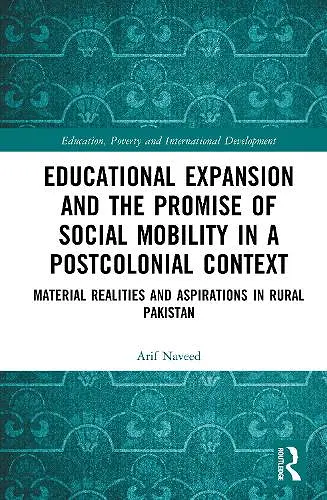
Arif Naveed’s scholarship offers an in-depth analysis of whether the promise of social mobility offered by the expansion of education in Pakistan has been delivered. It asks how education has impacted on the national poverty-education gap and whether education succeeds at a local level, given the powerful constraints associated with the social structure in rural Punjab.
The volume offers new theoretical and methodological tools for the study of social and economic mobility through education in a Southern context. The historical analysis of Pakistan’s educational reform and large-scale national statistical data sets uncovers the changing nature of the origins-education-destinations triangle. Using an innovative Habitus Listening Guide, the voices of fathers, mothers, sons and daughters reveal their aspirations and strategies to achieve taraqqi (‘a better life’), despite the social closure strategies used by the elite and the material realities that the disadvantaged face.
Compiled posthumously by a team of leading academics, this rich multi-dimensional study of education’s impact will be of interest to scholars and researchers in the fields of social mobility studies, international and comparative education, post-colonial studies, rural development and South Asian studies. Policy-makers will appreciate Naveed’s key insights about how to ensure that the education promise is fulfilled for all.
'This book is a brilliant example of the multi-modal scholarship that is required to truly excavate the complex relationship between education and social mobility. It offers a groundbreaking methodology to examine intergenerational social mobility in rural Pakistan, by listening deeply to the educational values, aspirations, experiences and strategies of families and households. These contextualised, polyvocal accounts are brought into conversation with policy histories and statistical evidence – creating a completely new approach to assess the ‘promise’ of education in relation to rural social structures in Pakistan. This book is essential reading to researchers and policy professionals who are looking to break from simplistic explanations of education’s social role.'
Arathi Sriprakash, Professor of Sociology and Education, University of Oxford, UK
'Arif Naveed was deeply committed to understanding the lives of Pakistan’s poorest citizens and the structures that shape their opportunities and aspirations. This posthumous volume reflects the full depth and maturity of his commitment, examining. the promise of educational expansion with intellectual rigour, empirical precision and genuine compassion. Schooling is not treated as a simple ladder out of poverty. Instead, land, caste, gender, patronage, household relations and local power structures are shown to shape the relationship between education and social mobility in rural Pakistan. Combining policy history, quantitative analysis and the lived experiences of families pursuing taraqqi, this book makes a significant contribution to development scholarship.'
Dr. Abid Qaiyum Suleri, Executive Director of the Sustainable Development Policy Institute, Chairman of National Disaster Management Fund, Pakistan.
'Educational expansion promises social mobility, even for the poor. But, does it fulfil this promise? This book makes a compelling case for rethinking modern society’s case for education – that it will lead to greater social mobility, even for the poor. The book offers a gripping reconceptualization of how educational expansion reshapes social structures within the complex realities of the Global South. A major contribution of this excellent read is its challenge to dominant frameworks and consideration of new analytical pathways to understand education’s transformative and sometimes contradictory effects in Pakistan. The book is ambitious in scope but grounded in empirical depth; it is an essential read for students, scholars, policy-makers and anyone who wish to understand if and how education can shape social transformation in postcolonial societies.'
Dr. Monazza Aslam, Managing Partner, Oxford Partnership for Education Research and Analysis (OPERA),UK
ISBN: 9781041274384
Dimensions: unknown
Weight: unknown
290 pages