Historical Understanding, Futures Thinking, and the Public Work of Curriculum
Throughline Questions for Preferable Futures
Format:Hardback
Publisher:Taylor & Francis Ltd
Publishing:24th Nov '26
£171.99
This title is due to be published on 24th November, and will be despatched as soon as possible.
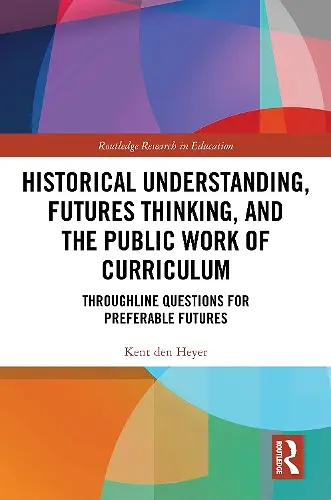
This book asks a deceptively simple question: What is education for? Drawing on curriculum theory, history and social studies research, education philosophy, Indigenous scholarship, and futures studies, it argues that schooling too often socializes students into inherited ways of knowing while neglecting education’s deeper democratic ‘Euro-American’ potential: to enable youth to make judgements about their nation‑state and cultural inheritances from a vivifying aesthetic, intellectual, and perhaps spiritual
sense of historical proportion as an exercise in freedom. Engaging with timely debates in education, such as the emergence of AI, the author makes the case for a pedagogical approach centred on the use of “throughline questions,” which ask students to connect subject matter to future thinking and critically examine their own role in shaping social worlds. Through innovative concepts such as KINships (knowledge–ignorance–privilege relations), curriculum‑as‑encounter narrative dexterity, and becoming “story smart,” this book outlines a path beyond both standardized schooling and decontextualized “best practices” towards learning organized around ethical inquiry, Treaty relationships, and preferable collective futures.
Recommended reading for educators and researchers with interests in democratic education, curriculum design, educational philosophy, and civic education.
ISBN: 9781041291848
Dimensions: unknown
Weight: unknown
186 pages