The Architecture of Violence
Towards a Theory of Infrastructural Harm
Format:Hardback
Publisher:Taylor & Francis Ltd
Published:31st Aug '26
£171.99
Supplier delay - available to order, but may take longer than usual.
This hardback is available in another edition too:
- Paperback£43.99(9781041348023)
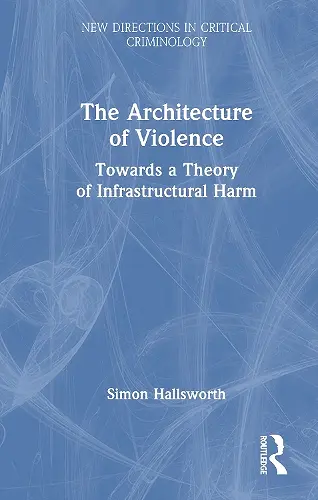
This book offers a new way of understanding harm in modern society. Rather than treating violence as the result of breakdown or failure, it argues that many forms of harm are built into the very systems designed to organise and protect social life. Laws, institutions, technologies, and policies can produce damage not by malfunctioning but by working exactly as intended.
Drawing on examples ranging from zones of suspended legality and emergency governance to the theatrical display of political power, the book shows how violence is woven into the normal operation of States and organisations across different regions of the world. It combines theoretical insight with concrete analysis to reveal how systems that promise security and progress often depend on sacrifice, waste, and destruction. The book also proposes a new framework for studying harm that moves beyond traditional approaches in criminology and social science. By rethinking criminology’s spatial topography and by attending to how institutions 'feel', it provides readers with tools for analysing contemporary problems such as State violence, border control, technological governance, and systemic inequality.
Written as an exercise in criminological noir, wide-ranging in scope, yet clear in argument, The Architecture of Violence speaks to readers interested in power, society, and the hidden structures that shape everyday life.
With The Architecture of Violence, Simon Hallsworth offers criminology not just a paradigm shift, but something closer to a paradigm shove – a shove past criminology’s clean Euclidian categories, and deep into the entangled dynamics of a post-Euclidian criminology. By way of this new paradigm, he reveals a disturbing world of endemic organizational harm and encoded adulteration, a world where official violence emerges from perverse desires and lurid machines. Drawing on cultural criminology to understand these sensualities of institutional violence and control, he in turn usefully reorients cultural criminology’s attention to the affective operations of the powerful. All in all, a book of intellectual daring and dark revelation.
Jeff Ferrell, author of Drift: Illicit Mobility and Uncertain Knowledge
Let's be honest with ourselves: no one cares about criminology anymore. The discipline has broken into a thousand pieces that for the most part refuse to engage with one another. Most of the fragments that once made up the discipline have turned away from motivation and the root causes of crime and harm. Genuine theoretical work has disappeared, careerism is endemic, inert activism has replaced objectivity, and the contemporary obsession with data isn't taking us anywhere we haven't already been.
A good caricature always contains a kernel of truth. There are certainly good reasons for those who love criminology to feel despondent. However, criminology isn't dead yet. There are still individuals willing to construct new and ambitious frameworks that allow us to better understand the forces that drive conflict, split apart communities, corrode sociability and damage particular individuals and groups. In TheArchitecture of Violence, Simon Hallsworth reimagines criminology's topographical order. He proposes the discipline move to a post-Euclidian model that dispenses with the binaries and flat structures that have predominated throughout its history. Hallsworth pushes criminology to accept the entanglements and complexities of the world as it is. Ambitious, far-sighted and beautifully written, this might just be the book that drags criminology out of the mire and refocuses its attention on what truly ails the world.
Simon Winlow, Professor, Northumbria University
This is a typically innovative, bold and provocative body of theorizing from one of our leading scholars spanning the borderlands of criminology, cultural studies and sociology. This book will be of great significance in the growing inter-disciplinary subject areas of state violence and social harm more generally. The book is also very timely and much needed: the current criminological-sociological debate on state power and crimes of the powerful has become somewhat lacking in innovative research-theorizing due in part to the intellectual constraints embedded in the neo-Marxist, zemiological, and post-colonial critical orthodoxies. Simon Hallsworth’s espousal of what he terms a ‘criminology noir’ has great potential to help us both re-think and re-enliven radical debate on violence and the contemporary cultures of control into the 21st century. The text is quite unique and challenging in its paradigmatic claims. The conceptual originality, scope and breadth of this book should guarantee it a global significance for years to come.
Gordon Hughes, author of Crime, Violence and Modernity, and Professor Emeritus in Criminology, Cardiff University, UK
ISBN: 9781041348016
Dimensions: unknown
Weight: 420g
282 pages