Cohabitation in International Relations
Managed Competition in Fragile States
Format:Hardback
Publisher:Taylor & Francis Ltd
Publishing:17th Nov '26
£55.99
This title is due to be published on 17th November, and will be despatched as soon as possible.
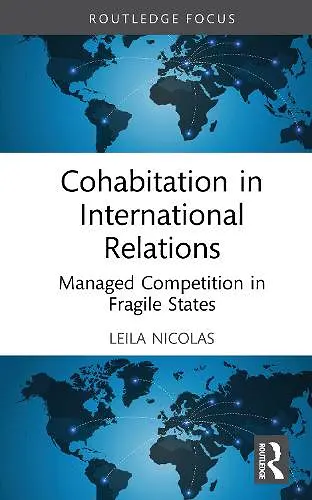
Cohabitation in International Relations offers a groundbreaking framework to explain why, in a world of intense Great Power Competition, rival powers sometimes tolerate each other’s presence in weak states rather than engaging in full-scale conflict.
Why do the United States and Iran coexist in Iraq, while Russia and the West fight a proxy war in Ukraine? Why do some weak states become shatterbelts, while others maintain an uneasy state of overlapping influence? When a distant Global Power encounters a neighboring Regional Power with deep historical ties, they often enter a tense but durable stalemate—a “fragile equilibrium” where displacement is costly. This book draws on cases from the Middle East, South Asia, and Post- Soviet space, the Western Hemisphere and Africa, and identifies the structural rules governing this phenomenon, including ‘The Actor Rule’, ‘The Influence Rule’ and ‘The Proximity Rule’. By formalizing a framework that no existing theory fully explains, this book fills a critical gap in IR scholarship. It redefines contemporary statecraft, showing that success is no longer measured only in battlefield victories, but in managing the complex, high-stakes reality of living alongside rivals.
Cohabitation in International Relations is essential reading for scholars, students, policymakers, and analysts in International Relations, Security Studies, and Geopolitics.
"In her inspiring new book, Dr. Leila Nicholas accounts for how rival powers manage to produce overlapping influence in weak states. The book develops the Theory of Cohabitation to explain how a global power and a regional power challenge one another in a weak state while neither is able to exclude the other, generating cohabitation as the least costly mechanism for both. Ultimately, the book neatly explains the conditions under which such an equilibrium holds. Dr. Nicholas presents these issues with clarity and vigor, thus providing a highly valuable contribution to the field of international relations in the age of multipolarity."
Dr. Toni Alaranta - Senior Research Fellow. The Finnish Institute of International Affairs
"Dr. Leila Nicolas's Cohabitation Theory offers a timely, rigorous framework for analyzing great-power competition within weak states. By introducing the "Diagnostic Matrix" and concepts like "functional allocation, this book provides international relations scholars and policymakers with valuable analytical tools to evaluate how rival external powers manage overlapping influence and navigate structurally complex, multipolar environments. For Korean diplomats, who operate in one of the world's most complex strategic environments, the analytical framework presented in this book is both timely and highly relevant."
Mr. Kihyun Noh, Second Secretary and Consul at the Embassy of the Republic of Korea to Lebanon and Syria.
"Dr. Leila Nicolas brings fresh clarity to a complex field. Cohabitation in International Relations offers vital insights for scholars and policymakers on managing competition in fragile states and navigating gray-zone conflict. In addition to what it offers, the book also discusses her original theory of “cohabitation” as a practical idea that can be used to sustain stability without collapse."
BG. Elias Aad, PhD, Head of the Border Control Committee- Lebanese Armed Forces
"Dr. Leila Nicolas challenges conventional thinking about great-power competition with an innovative and timely theoretical framework. Combining conceptual originality with wide-ranging empirical analysis, Cohabitation in International Relations offers a compelling explanation of how competing powers coexist and manage influence in fragile states, while shedding important light on the dynamics of power and governance at the local and regional levels in an increasingly decentralized, multipolar system. Provocative, accessible, and highly relevant, this book is an important addition to contemporary debates on international order and geopolitical competition."
Zenonas Tziarras, Department of Turkish and Middle Eastern Studies, University of Cyprus
ISBN: 9781041355168
Dimensions: unknown
Weight: unknown
162 pages