Tibet’s Climate Crisis
Power, Politics, and China’s Environmental Statecraft
Format:Hardback
Publisher:Taylor & Francis Ltd
Publishing:15th Dec '26
£171.99
This title is due to be published on 15th December, and will be despatched as soon as possible.
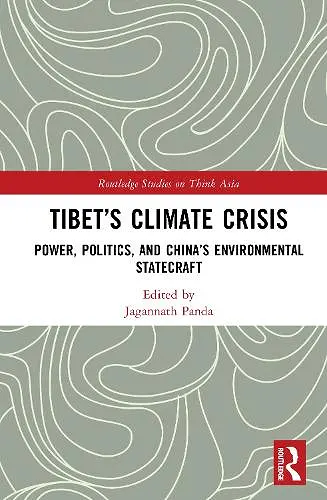
This book offers one of the first comprehensive, policy-oriented examinations of the Tibetan Plateau as both a global climate regulator and an emerging geopolitical frontier, providing a holistic framework for understanding one of the world’s least examined, most consequential environmental crises yet.
Bringing together leading international scholars, policy practitioners, and regional experts, this volume argues that Tibet’s environmental transformation cannot be understood solely through the lens of climate change. Instead, it demonstrates how environmental governance, strategic infrastructure, resource extraction, militarization, demographic engineering, and hydro-politics have become integral instruments of China’s broader statecraft, with far-reaching consequences for Asia and the international order. Chapters reveal how the ecological deterioration of the Tibetan Plateau is increasingly intertwined with questions of regional security, water governance, climate diplomacy, and strategic competition. The book explores how developments around the “Third Pole” affect the future of Asia’s major river systems, food and water security, border stability, and the credibility of global climate governance. At its core, the volume contends that Tibet is no longer a peripheral environmental concern, but a central strategic issue with profound implications for the Indo-Pacific and beyond.
Bridging a major gap in contemporary scholarship and policy debate, this book serves as an indispensable resource for researchers and postgraduate students in the fields of environmental politics, security studies, and East Asian studies. Policymakers, strategic planners, and climate negotiators exploring how environmental change on the Tibetan Plateau is reshaping geopolitics, regional security, and the future of global climate governance will also benefit.
"Geopolitics has shaped not only the Tibetan environment, but also that of continental Asia and beyond. This argument lies at the heart of Tibet’s Climate Crisis: Power, Politics, and China’s Environmental Statecraft. This volume, deftly edited by Jagannath Panda, brings together leading scholars to consider the relationship between environmental decline and Chinese government policy. Deteriorating conditions are not neutral. Instead, Tibet’s environmental riches have been harnessed as political objects. Repercussions extend well beyond Tibet, impacting Asia’s major rivers, growth seasons, and atmospheric circulation patterns in ways that touch on economic, food, and political security in multiple counties. Tibet’s Climate Crisis lays out the issues clearly, urgently, and expertly. All concerned with the political causes and cover-ups of climate change should read this book. Its lessons from the Roof of the World are sadly global."
-- Carole McGranahan, Professor of Anthropology, University of Colorado, USA, and President, American Ethnological Society.
"Edited by Jagannath Panda, Tibet’s Climate Crisis is a powerful, incisive, and remarkably well-conceived volume that brings analytical depth to one of the world’s most neglected environmental challenges. Bringing together climate change, PRC’s environmental statecraft, resource extraction, militarization, water security, and Tibetan livelihoods, the book reveals how Tibet’s ecological future is inseparable from Asia’s wider security. This is an important and timely contribution that demands serious international attention."
-- Lobsang Sangay, Harvard Law School, and Formerly Sikyong (President), Central Tibetan Administration.
"The Tibetan Plateau and its surrounding mountains hold the largest reservoir of frozen fresh water outside the two poles but is the only such supply with half of the world’s population living on its doorstep. Global climate change is transforming these Asian highland regions rapidly and with devastating effect. As water cycles accelerate, permafrost layers fragment and mountain slopes destabilise, the policies and strategies of the People’s Republic of China in Tibet will affect populations all across Asia. This welcome collection opens the door on the political, policy and practical challenges that presently face all of Asia’s governments, and frames our understanding of the disruptions to come.
-- Martin A. Mills, Director, Scottish Centre for Himalayan Research, University of Aberdeen, Scotland.
"This timely volume brings together a very distinguished and international group of scholars who collectively address an urgent topic of research and social relevance, namely an investigation of how the People's Republic of China manages water resources on the Tibetan plateau. Tibetan glaciers are the most important water resource in Asia. Likewise, the threat of climate change to the glaciers is relatively understood. However, scholarship and policy planners have neglected that the much of the Tibetan plateau is permafrost, which is now quickly warming alongside said glaciers. Though Chinese language scholarship has connected the two, and modelled the impact of climate change on their governance of Tibet, the phenomenon is largely unknown in English language scholarship. This volume will be an essential read for social scientists and policy makers throughout Asia and beyond."
-- Cameron David Warner, Associate Professor, Aarhus University, Denmark.
"For too long, Tibet has been treated as a remote periphery, a scenic backdrop to other people's politics. This volume reverses that gaze. Across dams, mining, permafrost and the displacement of nomads, it shows the 'Third Pole,' whose ice feeds the rivers of two billion, is not merely a victim but an instrument of statecraft. Its most vital insistence is the one most often forgotten: that Tibetans, least consulted and most exposed, belong at the centre of any reckoning with their homeland."
-- Dibyesh Anand, Professor and Deputy Vice-Chancellor, University of Westminster, UK.
"An urgent and credible wake-up call from analysts who have followed China's policies and impacts on the Tibetan plateau for decades. This volume shows why the deterioration of Tibet's environment is a matter of global climate and human security, not an internal Chinese affair — and, importantly, it offers answers rather than only alarm. Ignoring Tibet because it is politically sensitive would be a profound mistake, and this book explains precisely why."
-- Kate Saunders, Co-founder, Turquoise Roof.
ISBN: 9781041423485
Dimensions: unknown
Weight: unknown
248 pages