Beyond the Bedside
A Narrative Model of Knowledge Translation in Reproductive Health
Mona Baker author Eivind Engebretsen author
Format:Paperback
Publisher:Cambridge University Press
Publishing:30th Sep '26
£40.00
This title is due to be published on 30th September, and will be despatched as soon as possible.
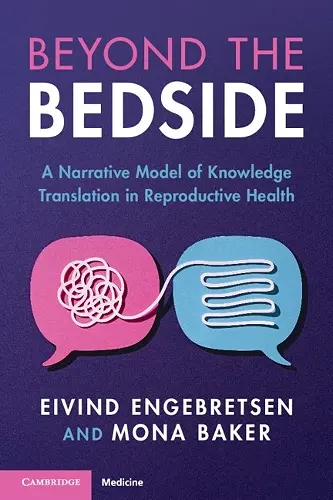
Explores how storytelling shapes medical evidence, showing why controversies arise and how diverse narratives transform healthcare knowledge.
This work explores how storytelling shapes medical evidence from research to policy to practice, showing why controversies arise and how diverse narratives transform healthcare knowledge. It also uncovers why evidence so often fuels conflict rather than consensus. Available as Open Access on Cambridge Core.This book makes a bold but crucial claim: storytelling is not an embellishment to medical knowledge-it is the engine that drives it. Evidence becomes meaningful only when it is framed and interpreted within existing stories. Focusing on reproductive health, Beyond the Bedside explores diverse understandings of medical evidence in relation to some of today's most contested topics, including embryo selection in IVF, puberty blockers for transgender youth and abortion care. Across these cases, the authors reveal how identical evidence can lead to starkly different syntheses, guidelines, and public positions, depending on the narratives into which it is woven. Introducing the concept of deep knowledge translation, the book offers a new way of analysing how evidence moves across research, clinical practice, policy, law, and public debate. It shows why medical controversies persist and how understanding narrative dynamics can transform the way we produce and use knowledge. Available as Open Access on Cambridge Core.
'Engebretsen and Baker have long been at the forefront of expanding narrativity beyond the remit of traditional narrative medicine. In Beyond the Bedside, they clearly and comprehensively demonstrate how a reflexive and narrative model of knowledge translation can ethically address the plurality of value-laden and conflicting stories that circulate within and beyond medicine, shaping, guiding, and clashing with personal and corporeal experiences. As the authors argue, knowledge, once inscribed, is always bound to be re-narrated. And once you see the narrative workings of medicine and science, you cannot unsee them.' Şebnem Susam-Saraeva, Personal Chair of Translation Studies, University of Edinburgh
'Engebretsen and Baker have written a book that every clinician who has ever puzzled over why good evidence fails to change practice should read. Their central insight – that knowledge translation is not a technical pipeline but a narrative process, shot through with values, power, and competing storylines – illuminates why medical controversies so rarely resolve themselves, even when more data accumulate. The reproductive health case studies (puberty blockers, IVF embryo selection, abortion care) are compellingly analysed and painfully timely: these are precisely the areas where clinicians feel the ground shifting beneath them, where the same evidence base seems to authorise diametrically opposed guidelines and public positions. The concept of 'deep knowledge translation' offers a genuinely new and clinically useful lens – asking not just 'what does the evidence say?' but 'within whose story does it say it?'. This is a landmark contribution to medical humanities that deserves a wide readership among clinicians, policy-makers, and anyone who wants to understand why evidence so often fuels conflict rather than consensus.' Trisha Greenhalgh, Professor, University of Oxford
'Engebretsen and Baker's book critically traces how knowledge is transferred in three notable reproductive health cases. It challenges the traditional separation between the humanities and science by proposing a narrative model of knowledge translation. This model considers not only what is recognised as knowledge in each case but also explores the complex relationship between narrative, power, and evidence. It raises questions about the nature of knowing and who shapes the stories that matter in medicine. What is unique is that the authors extend narrative medicine's ethic of attention beyond the bedside to encompass the entire translational process. At the same time, they resist the tendency, highlighted by their seven principles of deep knowledge translation, to let operationalization reduce diverse perspectives to premature consensus.' Mette Terp Høybye, Professor of Medical Anthropology, Interacting Minds Centre, Department of Clinical Medicine, Aarhus University, Denmark
ISBN: 9781047756280
Dimensions: unknown
Weight: unknown
136 pages