Spending to Win
Political Institutions, Economic Geography, and Government Subsidies
Format:Paperback
Publisher:Cambridge University Press
Published:23rd Jan '20
Currently unavailable, and unfortunately no date known when it will be back
This paperback is available in another edition too:
- Hardback£94.00(9781108422321)
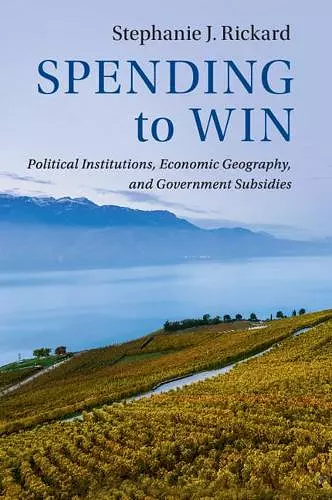
Explores how political institutions and economic geography interact to shape governments' policy decisions, particularly with respect to subsidies.
Why do some democracies redistribute more than others? Election practices cause some governments to deliver policies, such as industrial subsidies, that assist small groups of citizens at the expense of many. Spending to Win will find interest amongst scholars of international political economy, public policy, public administration, and comparative politics.Governments in some democracies target economic policies, like industrial subsidies, to small groups at the expense of many. Why do some governments redistribute more narrowly than others? Their willingness to selectively target economic benefits, like subsidies to businesses, depends on the way politicians are elected and the geographic distribution of economic activities. Based on interviews with government ministers and bureaucrats, as well as parliamentary records, industry publications, local media coverage, and new quantitative data, Spending to Win: Political Institutions, Economic Geography, and Government Subsidies demonstrates that government policy-making can be explained by the combination of electoral institutions and economic geography. Specifically, it shows how institutions interact with economic geography to influence countries' economic policies and international economic relations. Identical institutions have wide-ranging effects depending on the context in which they operate. No single institution is a panacea for issues, such as income inequality, international economic conflict, or minority representation.
'Spending to Win shows that the interplay of national economic structure and national electoral systems has a powerful impact on economic policy. In it, Stephanie J. Rickard analyzes how the geographical distribution of economic activity interacts with the character of electoral institutions to affect politicians' incentives to cater to special interests. Spending to Win is an original, creative, and compelling contribution to our understanding of the making of economic policy. It is a must read for anyone interested in economic policy, political economy, and electoral institutions.' Jeffry Frieden, Stanfield Professor of International Peace, Department of Government, Harvard University, Massachusetts
'Rickard's book asks an important question in political economy: why do governments sometimes respond to the broad public and other times to special interest groups? Given that this response affects who gets what when, this research focuses on a central issue in politics. The answer given is also novel, combining economic geography and political institutions. Rickard shows that economic policies that most benefit geographically concentrated special interest groups are more common in countries with plurality electoral systems, like the United States. However, providing economic benefits to geographically diffuse groups is the best strategy for parties in proportional representation systems. Her research helps solve the puzzle of why concentrated interest groups sometimes get what they want in politics and sometimes are unable to. The book examines several countries, including France, Austria and Norway, in much greater detail. The research has wider implications for areas like ethnic politics and international relations, making it an invaluable study in comparative political economy.' Helen V. Milner, B. C. Forbes Professor of Politics and International Affairs, Princeton University, New Jersey
'A refreshing new perspective on the economic effects of electoral rules, supported by new evidence and a rigorous analysis of the interaction of geography and politics. This book makes a path-breaking contribution to the analysis of modern democracies, and sheds new light on the political and institutional determinants of particularistic economic policies.' Guido Tabellini, Intesa Sanpaolo Chair of Political Economics, Università Commerciale Luigi Bocconi
'By inventively operationalizing the previously under appreciated variable of geographic concentration of industries, Rickard greatly advances and refines our understanding of the link between electoral systems and protection. Both her logic and her marshaling of evidence are impeccable.' Ronald Rogowski, Distinguished Global Visiting Professor, New York University Abu Dhabi
'Rickard's book provides a clear and compelling theory of subsidies to special interests across the world's wealthy democracies. Its account of how electoral institutions interact with geographic dispersion of industries is at once simple and powerful. The study makes a particularly important contribution to our understanding of economic policies directed to special interests in systems of proportional representation.' Miriam Golden, University of California, Los Angeles
ISBN: 9781108432030
Dimensions: 230mm x 152mm x 15mm
Weight: 400g
264 pages